.png)

1
Sep
Ultimate Explainer
Cap, Captain & Chaos: Master SuperCoach NBL


SuperCoach NBL Classic
How SuperCoach NBL Classic works: the $2m salary cap, ten-player squad, scoring, trades and lockout.
- Ten players, four guards, four forwards, two centres, all under a $2 million cap.
- Blocks and steals score three, the same as a three-pointer. Fouls score nothing.
- Two trades a round, four Trade Boosts a season, first lockout 19 September.
$2 million salary cap, 10 players, and more selection headaches than Australian Boomers coach Adam Caporn and Australian Opals coach Sandy Brondello combined: that's SuperCoach NBL Classic.
You are the SuperCoach; it's your team, and you are responsible for building it from the ground up before the first "Lock Out" on September 19, 2026 at 7.30pm AEST when Melbourne United host the Adelaide 36ers in the first game of NBL27.
How to sign up for SuperCoach NBL
Go to SuperCoach NBL: if you've already signed up, sign in, and if you're new to SuperCoach NBL, create an account. It's FREE to play.
Follow the prompts to create your team name, choose a logo, and select your preferred team colours. There are loads of options (the uglier the better, we say).

Picking your first SuperCoach NBL team
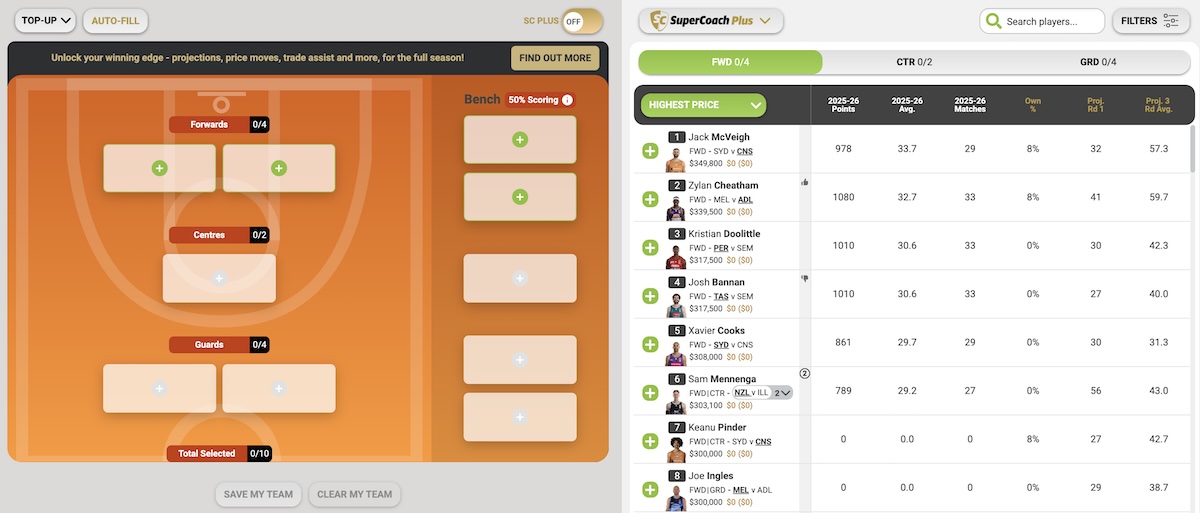
Simple, start building your team. Every player has a value, and every team requires four (4) guards, four (4) forwards, and two (2) centres: five (5) starters and five (5) on the bench.
But here's the catch: you can only spend $2M or less, so loading up with six-time MVP Bryce Cotton ($473,900), two-time MVP runners-up Kendric Davis ($436,000), New Zealand Breakers guard Parker Jackson-Cartwright ($405,200) and Cairns Taipans superstar Jack McVeigh ($349,800) will soak up more than three quarters of your cap on just four players.
Fear not, you don't have to be an accountant; SuperCoach NBL tracks your team value, and changes to your team before the first lockout are limitless until you get the team you want … under the salary cap. Real-world roster-building meets Fantasy Salary Cap.
But during the season, SuperCoaches can make only two trades per round, which means form and injuries become title-winning factors unless you pull the trigger on a Trade Boost.
SuperCoaches can make a third trade (Trade Boost) at any time, but only four times during the season.
How SuperCoach NBL scoring works
Your SuperCoach NBL Team accrues points based on how the real players you have selected perform on the court for their respective teams.
SuperCoach NBL Scoring Explained
- Two-point Field Goal = 2 Points
- Three-point Field Goal = 3 Points
- Free Throw = 1 Point
- Rebound = 1 Point
- Assist = 2 Points
- Block = 3 Points
- Steal = 3 Points
- Turnover = -2 Points
- Double Double = 5 Points
- Triple Double = 10 Points (supersedes Double Double)
- Your captain, which you choose every week, is awarded double their score.
- Players on your bench contribute 50% of their overall individual SuperCoach totals to your team's weekly points total, with any half-point rounded up.
- Personal fouls do not accrue positive or negative points.
For example, Bryce Cotton's five-game series against the Sydney Kings in the NBL26 Grand Final Series would have been scored like this (double if he was your captain):


Bryce Cotton v Sydney Kings — what each game scored
| Game | PTS | REB | AST | BLK | STL | TO | PF | BONUS | SC |
|---|---|---|---|---|---|---|---|---|---|
| Game 1 | 10 | 3 | 7 | 0 | 2 | 4 | 2 | — | 25 |
| Game 2 | 28 | 6 | 6 | 0 | 3 | 5 | 1 | — | 45 |
| Game 3 | 15 | 3 | 12 | 1 | 1 | 5 | 3 | +5 | 43 |
| Game 4 | 19 | 5 | 12 | 0 | 0 | 2 | 1 | +5 | 49 |
| Game 5 | 35 | 4 | 9 | 1 | 1 | 4 | 4 | — | 55 |
| Series | 107 | 21 | 46 | 2 | 7 | 20 | 11 | +10 | 217 |
SuperCoach does not follow the scoreboard. Game 2 was his 28-point night and scored 45. Game 4, with 19 points, scored 49 — 9 fewer points, 4 more SuperCoach points. He had 12 assists to 6, and two turnovers to five.
BONUS is the double-double: two categories at 10 or more, worth 5. A triple-double is worth 10.
Shooting percentages are left out on purpose. SuperCoach pays each made shot its scoreboard value, so the shooting half of the score is simply the points column; the percentages never enter it.
- When an NBL team plays twice in a round, it means two opportunities for your player(s) and captain to score more points than a single game. Understanding "Double-headers" is key to beating your friends or winning some cash.
- On the flipside, if you select a player who doesn't play, it's no points, nor mercy.
SuperCoach NBL squad structure: four guards, four forwards, two centres
Every SuperCoach NBL team must have the correct number of players in each position from any of the 10 NBL clubs.
- 4 x Guards
- 4 x Forwards
- 2 x Centres
Captain and Vice-Captain: how double points work
Choose a Vice Captain (VC) every week as well as your Captain (C). If your captain is a late-out and doesn't play, or you forget(!!), the captaincy is shifted to the Vice Captain and the same double-points system applies.
The $2 million salary cap explained
The only way you can save and enter your team is if it has 10 players and is on or under the $2M Salary Cap. Before the first Lockout, incomplete teams can be saved while you're making your selection decisions.
Explore the Player lists by position, price and team in the panel on the right-hand side of the SuperCoach NBL interface and click on them to add them to your team.
SuperCoach NBL will track your team's total cost and alert you if you exceed the salary cap. It's a hard blocker.
Auto-Emergency Player
If one of your starting five does not play and scores 0, SuperCoach covers you automatically. You do not have to do anything, nor do you have to name an emergency in advance.
One bench player is promoted for that round. Instead of the usual 50 per cent, they contribute 100 per cent of their points.
The player promoted is the lowest-scoring player on your bench who has actually scored. A bench player who did not play cannot be promoted, because a score of 0 makes them ineligible.
Two limits worth knowing. You get one auto-emergency per round, regardless of how many of your starters miss. And no more than five players can ever contribute 100 per cent of their points in a round.
Auto-emergency: a worked example
Say one of your starting five is a late withdrawal and scores 0. Your bench scores 40, 32, 28, 15 and 0.
Normally the bench would give you half of each score, with any half-point rounded up: 20, 16, 14, 8 and 0, for 58.
The auto-emergency promotes the 15, because it is the lowest score above zero. That 15 now counts in full rather than as 8, so your bench gives you 65. The player on 0 is not eligible, and the 40 is not promoted, because the rule takes the lowest, not the highest.
FAQ: Frequently Asked Questions
SuperCoach NBL: your questions answered
Getting started
Is SuperCoach NBL free to play?
How many players do I pick, and in what positions?
What is the salary cap?
When does my team lock in?
How scoring works
How do my players score points?
- Two-point field goal 2
- Three-point field goal 3
- Free throw 1
- Rebound 1
- Assist 2
- Block 3
- Steal 3
- Turnover −2
- Double-double 5
- Triple-double 10
Do personal fouls cost me points?
Does that mean the best scorers make the best picks?
What does my captain do?
What is the vice-captain for?
What if my captain AND vice-captain both do not play?
One of my players scored negative points. What happens?
The auto-emergency does not rescue you here either. It only triggers for a starter who does not play and scores 0, which a negative score is not.
How do bench players score?
What is the auto-emergency, and do I have to set one?
The player promoted is the lowest-scoring bench player who actually scored. That is the opposite of most fantasy games, and it is deliberate. A bench player who did not play cannot be promoted, because a score of 0 makes them ineligible.
You get one auto-emergency per round however many of your starters miss, and no more than five players can ever contribute 100% in a round.
Can you show me the auto-emergency with numbers?
Normally the bench gives you half of each, rounded up: 20, 16, 14, 8 and 0, for 58.
The auto-emergency promotes the 15, because it is the lowest score above zero. It now counts in full rather than as 8, so the bench gives you 65. The player on 0 is not eligible, and the 40 is not promoted, because the rule takes the lowest, not the highest.
What happens when a club plays twice in a round?
Do Ignite Cup games count?
What if one of my players does not play at all?
Running your team
How many trades do I get?
Do player prices move?
The icons on your team screen
What do the letters beside each player mean?
- S substitute a player out of or into your starting five
- T trade the player
- C make the player your captain (2x points)
- V make the player your vice-captain (2x points if your captain does not play)
What do the status symbols beside each player mean?
- Reported injured
- Subject to a fitness test
- Suspended
- Selected in the match-day squad
- Not selected to play in the upcoming week
- Has a bye next round
- Locked and cannot be edited, because the match or round has started
- No longer in the NBL
- May play in multiple matches this round, if selected for one or more
The last one is the one that wins rounds: it flags a player whose club has a double-header.
Research and tools
Where do I find the stats to pick a team?
What can I do with the player rankings?
There is a summarised view and a comprehensive one, the second carrying every stat and fantasy score the competition uses.
Which sort options are actually worth using?
- Most popular, as selected by other SuperCoach NBL coaches, which is how you find a point of difference by avoiding it
- Who’s Hot, the most improved players
- Gone Cold, those in a scoring slump
What is on a player profile?
You can add any player to your watchlist and follow them from your team screen.
How will I hear about injuries and late changes?
What does SuperCoach Plus add?
Leagues
How many leagues can I be in?
What is the difference between head-to-head and an open league?
An open league has no fixture and no size limit. Everyone is ranked on total points, which suits an office or club competition.
What is the difference between a public and a private league?
A private league is yours to run: choose head-to-head or open, invite whoever you like, and add any of the available Experts to play against. As administrator you can also remove teams, up until the league is finalised.
When does my league start, and who plays who?
8-team head-to-head leagues, private only, begin in Round 3 and every team plays every other twice, through Rounds 3 to 16.
Can I set up a league my own way?
How do league finals work?
Why does my draw look uneven?
How do I compare against everyone, not just my league?
How are the club and state rankings worked out?
There is also a ranking of the best performing private and public leagues in the competition.
What can I do on the rankings screen?
When is my place in a league locked in?
What happens if my team is incomplete when a league starts?
What if the league itself is not full?
Scores and timing
Can I follow my score during the round?
When are scores final?
Because of the volume of statistics involved, delays happen. Allow up until 3.00pm east-coast time on the day after the round finishes before treating a score as wrong. That is AEST for the opening fortnight and AEDT from 4 October, when daylight saving starts.
When can I edit my team for the next round?
Prizes
What can I win?
Tap a question to open it. The list works without JavaScript, so it opens and closes even if nothing else on the page has loaded.
Prices move through the season, so any figure quoted in an article is a snapshot with a date on it.




















.jpg)