6
Nov
2026
Ultimate Explainer
What is NCAA and why 246 Aussies now play D1

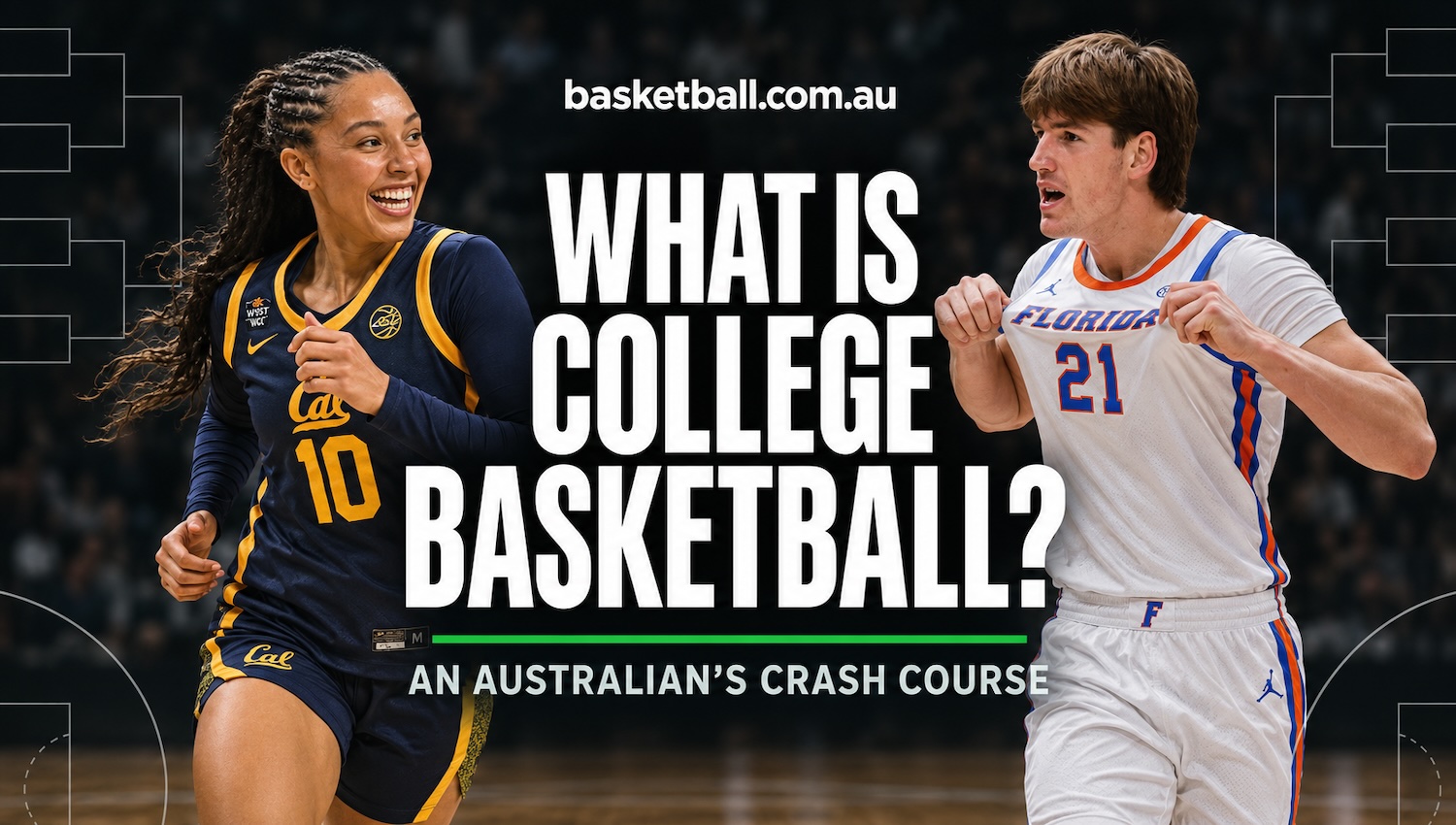
Lulu Twidale and Alex Condon both play college basketball in America. Photos: Getty Images
From scholarships to the transfer portal, a plain guide to the US college game 246 Aussies now play
- Aussie college stars: Find how to watch every one
- Every Australian in NCAAW basketball in 2026-27
- Every Australian in NCAAM basketball in 2026-27
NCAA Division I basketball is the top tier of American college basketball, a 361-school competition running from November to April, and 246 Australians are playing in it in 2026-27, according to basketball.com.au's trackers.
That is 91 men on our NCAA men's tracker and 155 women on our NCAA women's tracker, and for anyone in Australia following one of them, it is a competition that works nothing like the NBL or WNBL.
Players are recruited by schools rather than drafted, they have a limited number of years to play, they can change schools through a transfer portal, and the season ends in a knockout tournament that has grown to 76 teams.
College basketball in America is a tradition pathway for Australians to make it to the NBA, WNBA, NBL, WNBL or Europe.
Here is how it all fits together, from the schools and conferences to scholarships, eligibility and how to watch from Australia.
1. What the NCAA is, and what Division I means
The National Collegiate Athletic Association (NCAA) runs college sport across more than 1,000 colleges and universities in three divisions.
Division I is the highest level, and the NCAA's 2026-27 facts and figures list 361 active Division I schools in 32 voting conferences, against 297 schools in Division II and 416 in Division III.
The difference that matters most to an Australian family is how study gets paid for. The same NCAA document says Division I offers multi-year, cost-of-attendance athletics scholarships, Division II uses a partial-scholarship model, and Division III offers no athletics scholarships at all. In Division II, a basketball team can award up to 10 scholarship equivalencies, which coaches can split between players, the NCAA says.
When basketball.com.au publishes articles about Australians in the NCAA, we mean Division I, which is what our two trackers count and what our NCAA hub covers.
2. How many teams and conferences are there?
The number of Division I programs has climbed steadily, from 282 men's teams and 277 women's teams in 1985 to 361 men's and 359 women's teams, according to NCAA.com in May 2026. Those figures move as schools join, leave or reclassify, so treat them as a snapshot of the 2026-27 season rather than a fixed number.
Every school plays in a conference, and the conference is the unit that matters most in March, because each of the 32 conferences sends its tournament winner to the NCAA Tournament. Australians are spread across many of them. Portland has five Australian men, more than any other program, while Saint Mary's has four, according to our men's tracker, and Utah, Saint Mary's and TCU are among the women's programs carrying several Australians, according to our women's tracker.
3. When is the season?
The 2026-27 men's season runs from Sunday, November 1 through to the national championship game on Monday, April 5 (US time), and it opened with a Notre Dame and Villanova double-header in Rome, the men followed by the women. Because the games are played on US time, most of them tip off overnight or in the morning in Australia, which is why our opening-day guide and our daily wraps run in AEDT.
The early weeks are full of non-conference games and men's multi-team events such as the Maui Invitational (November 23-25) and the Players Era tournaments in Las Vegas. Conference schedules then decide regular-season titles and the seedings for the conference tournaments, which are still being played in the days before the selection committees finish their work, according to the NCAA's Selections 101 guide.
Winning one sends a team to March Madness, and our 2025-26 coverage followed Oscar Cluff leading Purdue past Michigan in the Big Ten Tournament final and Harry Rouhliadeff and Anthony Dell'Orso winning conference titles.
Our live trackers show when and where every Australian man plays and when and where every Australian woman plays, with results filled in as the season goes.
4. March Madness and Selection Sunday, in brief
The season ends with the NCAA Tournament, better known as March Madness, and the fields are named on Selection Sunday, which falls on March 14, 2027 (US time).
This is the first season the men's and women's tournaments have 76 teams instead of 68, made up of 32 automatic qualifiers who win their conference tournaments and 44 at-large teams picked by the men's and women's basketball committees.
A new 12-game Opening Round cuts the field to 64, and it is single elimination from there. The men's Final Four is in Detroit on April 3 with the final on April 5, and the Women's Final Four is in Columbus, Ohio on April 2 with the final on April 4, all US time. For the full history, the bracket and how upsets happen, read our explainer on what March Madness is and how it works.
5. Scholarships, revenue sharing and NIL
A Division I athletics scholarship can cover tuition and fees, food and housing, and books, according to the NCAA's Guide for the College-Bound Student-Athlete. The money changed in 2025, when the court-approved House settlement took effect on July 1 and Division I rules dropped sport-specific scholarship limits in favour of roster limits, the NCAA said at the time. NCAA rules now also let schools share revenue directly with their athletes.
On top of that sits name, image and likeness (NIL) income, and it is more complicated for Australians than for American players. Our NIL explainer sets out how international athletes are being paid through a legal structure their own lawyers describe as fragile, and retired Sydney Kings captain Ben Madgen has spoken to us about beating the NIL trap, with our Moneyball piece setting his views beside those of Rich Paul and Jaylen Brown.
6. Eligibility: how long can a player stay?
For years the rule was four seasons of competition within five years. On June 23, 2026, the Division I Cabinet unanimously approved an age-based model that allows up to five years of eligibility for players who enrol no later than the academic year after their 19th birthday. It applies in full to players who first enrol in fall 2027 or later, while current players get whichever of the old and new rules is more favourable to them.
The rules have also been tested in court and by the conferences. A US court ruling on July 31, 2026 briefly reopened the college careers of four Australians who had already signed NBL27 contracts, including Perth Wildcats recruit Anthony Dell'Orso, as we reported in August, and the Big 12's new ban on rostering professional athletes left at least one Australian's college career in doubt. Our reporting on former South East Melbourne Phoenix guard Owen Foxwell's move to Wisconsin covers the international eligibility rules in more detail.
7. The transfer portal
Players who want to change schools enter the transfer portal, and for basketball the main window now opens for 15 days starting the day after the national championship game, and a separate 15-day window can open after a head coaching change, according to NCAA.org. It is a big part of how Australian careers move, and 68 Australians entered the 2026 portal, with 66 of them on 2026-27 rosters, according to our transfer portal tracker.
8. The Australians who came through college
College has been a pathway to the top of the game for a long line of Australians. Andrew Bogut played two seasons at Utah and was the college player of the year before the Milwaukee Bucks took him first overall in the 2005 NBA Draft. He has told the story of his Utah recruitment to basketball.com.au readers.
Patty Mills (2007-09), Matthew Dellavedova (2009-13) and Jock Landale (2014-18) all came through Saint Mary's to play in the NBA.
Washington Mystics guard Georgia Amoore played her final season of college basketball at Kentucky before being drafted to the WNBA last year.
Alex Condon forced a turnover on one of Houston's last two possessions as Florida won the 2025 national championship 65-63 and he is back at Florida for his senior season, rated the fifth-best player in Division I by analytics site Evan Miya, as we reported in September.
Our experts have also ranked the 10 best Australians in NCAA men's basketball history.
The next wave is already there. Our trackers list 26 Australian freshmen in the men's game and 52 in the women's, the 78-strong freshman class, while Sitaya Fagan is at USC and Cairns Taipans NBL Next Star Luke Paul has committed to Duke.
9. How to watch NCAA basketball in Australia
Where you can watch an Australian depends almost entirely on which conference their school plays in. When basketball.com.au checked all 246 Australians for our how-to-watch guide, 82 could be watched all season through conference passes that work from Australia, while 13 could not be watched legally at all, because we found no Australian route into the Pac-12. Most of the rest can be seen only in part, through the games ESPN Australia shows on Disney+ and the Big Ten and Big East games on DAZN, so check the guide before you subscribe.
10. What it all means
NCAA Division I is a 361-school competition with its own calendar, its own money and its own rules on who can play and for how long, and in 2026-27 it carries 246 Australians. Follow every one of them through our daily men's and women's wraps, the trackers and our Aussies in the NCAA page, and come back to this guide whenever the rules change, because in college basketball they keep changing.
More on Australians in the NCAA
- NCAA basketball news: men and women
- Latest news: Australians in the NCAA
- Every Australian in NCAAM basketball in 2026-27
- Every Australian in NCAAW basketball in 2026-27
- When and result of EVERY Australian game in NCAAM
- When and result of EVERY Australian game in NCAAW
- Aussie college stars: Find how to watch every one
- Where every Australian landed in the NCAA transfer portal
- Gems, Emus part of 78-strong 'Fabulous Freshmen' class