13
Dec
Rich Paul's Rules
NBA super agent reveals 5 secrets to being a pro

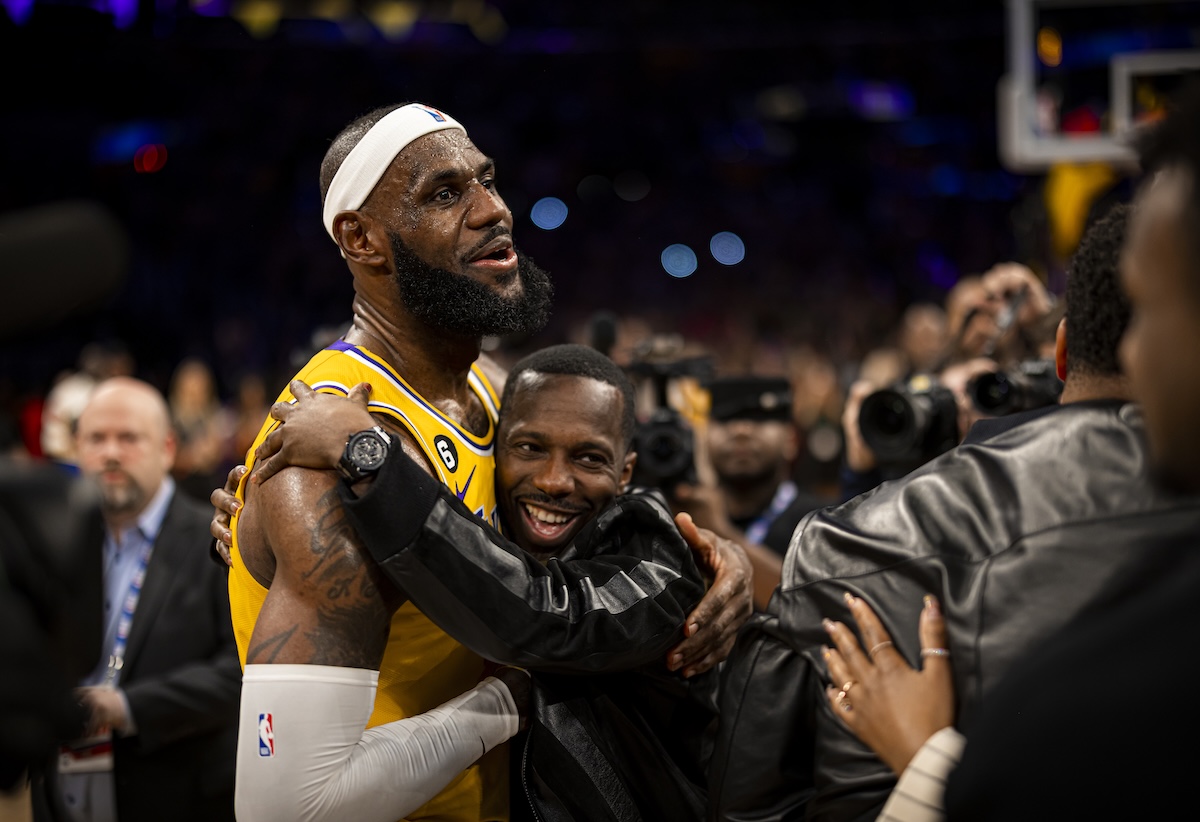
Super agent Rich Paul hugs LeBron James #6 of the Los Angeles Lakers after the game against the Oklahoma City Thunder on February 8, 2023 (AEDT) at Crypto.Com Arena in Los Angeles, California. Photo: Zach Beeker/NBAE via Getty Images
Rich Paul explains why role acceptance and fundamentals define NBA longevity more than raw talent.
- Reason why NBA champion Byron Scott says the famed triangle offense is dead
- Belgian coach Joerik Michiels: “Competitiveness, character create true pros”
- Player development: No excuse for not being a good free throw shooter
Super agent Rich Paul has revealed the secrets to becoming a long-term professional basketballer.
The 44-year-old is LeBron James' agent along with Anthony Davis and Draymond Green. Paul's secrets aren't just for NBA players, they are essential for all professional basketballers from WNBA, WNBL, NBL and semi-professional such as NBL1, national, and state emerging stars and Australian youth league.
Every Australian player with goals and dreams of being played to play basketball should print out Paul's advice (below) and pin it to their fridge.
"What I’ve learned just in the past couple years is going to a school or playing the most fundamental basketball you can play while you’re young, having an understanding of how to play without the ball, being coached really hard, and not being allowed to just do any and everything you want to do — which kids call 'getting in a bag' today," Paul told NBA Hall of Famer Carmelo Anthony on his 7pm in Brooklyn podcast.
"Because when you get to the NBA, you have to start in a role. A lot of guys that are talented and don’t make it or don’t last, it’s not because they can’t play in the NBA. You wonder, and these guys don’t understand.
"They’ll be like, 'Oh man, but I averaged 50 every time I got in. I scored'. Yeah, but you’re not starring in a role.
"So you can cook, but you can’t collaborate. You can cook, but you can’t digest information.
"You can cook, but you’re not willing to not be the focal point. And you don’t understand, when you take a step back from the league and look, he’s (Anthony) never had to be in that situation until he was at the end of his career.
"But he had so much confidence in himself, and his legacy was already cemented. So when he came to that point of his career, he was now loving the game. He went through a thing where me and him talked, where he just wanted to be back in the league and do it his way.
"You’re talking about a guy who made all the money, all the All-Star games, did game-winners, all of that. But his love for the game brought him to that space at that time.
"These guys that are at the end of the road, he already had the pot of gold, the rainbow, everything. These guys aren’t even on the road, and they’re not getting opportunity because they don’t understand how to start in a role.
"And it’s just one thing that’s sad, because all these high-ranked guys, they don’t really last. It’s because of that more than anything, in my opinion."
Anthony, now 41, is a 10-time NBA All-Star (2007, 2008, 2010–2017), two-time All-NBA Second Team (2010, 2013), four-time All-NBA Third Team (2006, 2007, 2009, 2012), NBA scoring champion (2013), NBA All-Rookie First Team (2004), and a member of the NBA 75th Anniversary Team. He averaged 22.5 points per game, 6.2 rebounds and 2.7 assists in 1,260 NBA games. He was inducted into the Hall of Fame this year, his first year of eligibility.
Anthony also won Olympic Games gold medals for the US Men's team in 2008, 2012 and 2016.
But late in his career, Anthony became a role player for the Portland Trail Blazers and Los Angeles Lakers.
"It starts with the development," Anthony said to Paul.
"You’re not being taught the game the right way anymore at a young age. So when you go to these combines and these colleges and try to make the pros, as you start getting older and bigger and stronger, everybody else is doing the same thing.
"Somebody you may have seen at 6’1” this year may come back 6’4” next year and 6’7” two years after that. So when you get to that level, to your point, as a role player — and I can attest to this because I had to, at the end, be at peace with that — I had to be away from the game in order to appreciate it.
"I had to say, 'You know what, I’m going to be at peace. I’m going to do it my way. I want to have fun. I want to enjoy the game, but I’m going to accept my role'.
"I had to take off the ego hat and the pride hat and say, 'You know what, I’m going to be cool with averaging 13, because that’s my role'.
"I can’t look at it like, 'Oh, I’m averaging 13 or 15', and compare that to where I was in New York averaging 28 or 29. Because if I’m doing my role, I feel like I’m having a very successful year.
"That was something mentally I had to accept. Not play the game, but really understand that in order for me to have fun with this game, I had to accept that role. And I don’t think kids have an opportunity from a young age to understand what playing a role is.
"You’re taught to roll the ball out and go play. You’ve got the best handles, you’re the best player at that age — until you meet somebody else who’s the best player at that age and realize you weren’t developed the right way.
"That’s the problem when they get to the pros, and even college. Some struggle their first year, their confidence drops, then they go into the transfer portal. You’re not putting the work in, and you didn’t understand what you just said."
Paul said the secret to longevity was understand your role and being a star in that role.
"I’ve had it at the beginning, and I’ve had it at the end," he revealed.
"The other issue is a lot of these guys are surrounded by people who don’t have the right information.
"Good, bad, right, or indifferent, you still have to check yourself. You can’t just say certain things because they’re searching. They’re searching for the words they want to hear, not the right words.
"It’s no different than a little kid going to you and saying, 'Dad, can I get—' and you say no. Then they go to grandma, she says yeah, and that’s who they’re going with. It’s the same thing in our industry.
"I don’t want to be a person where people say, 'You don’t want me listening to my people or my family'. That’s not it. What I’m telling you is what I know, straight from the horse’s mouth, because we’re all trying to help you better position yourself.
"They see it from one lens. If this person doesn’t get in the game or doesn’t get shots, that’s all they see. I’m looking at it holistically. I can only give it to you from a real place of education at the highest level.
"Not because it’s what you want to hear, and not because I’m trying to bamboozle you. I’m really trying to help. That’s a tough balancing act in my position, but that’s the role I have to play.
"And it’s okay. Sometimes you’ve got to be the man. You’ve got to do it."
The Five Secrets to Becoming a Veteran Professional (According to Rich Paul)
1. Learn the game before you learn the bag
Play fundamental basketball early. Learn how to play without the ball, be coached hard, and accept structure. Flashy skill without foundation doesn’t translate when roles tighten.
Talent gets you noticed. Fundamentals keep you employed.
2. Understand that everyone starts in a role
No matter how talented you are, the NBA starts you in a role. Players who fail often aren’t untalented — they just refuse to accept not being the focal point.
You don’t star immediately. You earn trust first.
3. Being able to “cook” isn’t enough
Rich Paul’s sharpest distinction:
You can cook, but can you collaborate?
You can cook, but can you digest information?
You can cook, but can you step back from being the centrepiece?
Longevity comes from adaptability, not shot-making.
4. Veteran mindset is about loving the game, not protecting status
True veterans rediscover the game by letting go of ego. Once legacy and money are secured, the love of basketball — and willingness to serve the team — is what keeps careers alive.
The game gives more to players who stop demanding from it.
5. Listen to people who tell you the truth, not what you want to hear
Young players often surround themselves with voices that reinforce entitlement. Rich Paul stresses the importance of holistic, uncomfortable truth over one-lens thinking about minutes, shots, or usage.
Growth comes from education, not validation.
Bottom Line (Rich Paul’s Philosophy)
Most NBA careers are not stardom — they are role mastery. Players who understand that early last longer, earn more, and enjoy the game deeper.
Who Is Rich Paul?
Full name: Richard Paul
Born: December 16, 1980 (age 44)
Birthplace: Cleveland, Ohio, U.S.
Occupations:
- Sports agent
- Founder & CEO, Klutch Sports Group
- Co-head of Sports, United Talent Agency (UTA)
Years active: 2003–present
Rich Paul emerged as one of the most influential figures in modern sports representation through a non-traditional path that reshaped athlete agency in the NBA.
Following the 2003 NBA Draft, Paul joined LeBron James’ inner circle, alongside Maverick Carter and Randy Mims. He later began working under Leon Rose at Creative Artists Agency (CAA), where Rose had negotiated James’ 2006 contract extension with the Cleveland Cavaliers.
In 2012, Paul and James left CAA to launch Klutch Sports Group, positioning it as a player-first agency with a strong emphasis on empowerment and control. In 2013, Paul recruited veteran agent and attorney Mark Termini to lead NBA contract negotiations for Klutch.
Business Expansion & Influence
- Klutch Conversations (2020):
Launched with SocialWorks and General Mills to promote financial literacy among youth. - UTA board appointment (2020):
Paul joined UTA’s board of directors. - Adopt (2021):
Co-founded a minority-owned marketing and creative agency with former Nike executives. - Fashion & culture:
Collaborated with New Balance on the NB550 sneaker release (2021) and later launched Klutch Athletics (2023), a sportswear brand. - Museums & entertainment:
Joined the LACMA board of trustees (2022) and the Live Nation Entertainment board (2023). - Funko investment (2022–2023):
Part of a $263 million consortium investment alongside Bob Iger, eBay, and The Chernin Group. Served as board advisor before resigning in late 2023.
Key NBA Clients
- LeBron James: The foundational client for Klutch Sports.
- Anthony Davis: A cornerstone player for the Lakers championship, now with the Dallas Mavericks.
- Draymond Green: A key player for the Golden State Warriors.
- Zach LaVine: A high-scoring guard for the Sacramento Kings
- Darius Garland: The franchise guard for the Cleveland Cavaliers.
- Tyrese Maxey: A breakout star for the Philadelphia 76ers.
- De'Aaron Fox: The leading guard for the San Antonio Spurs.
- Fred VanVleet: A veteran point guard for the Houston Rockets.
- Lonzo Ball: A dynamic guard for the Cleveland Cavaliers.
About the Author
Peter Brown is the head coach of the Sydney Comets Women’s Youth League team in the Waratah Basketball League in NSW. He is also the assistant coach for the Comets NBL1 women’s team in the NBL East Conference. Peter is a 30-year journalist, starting as a sports reporter at the NT News in the early 1990s. He played junior basketball for the Northern Territory at national championships from U16 to U20 and for the Territory’s senior men’s team at numerous international tournaments. Peter has been a basketball fan since the early 80s, especially the NBA. Basketball is his passion — and his opinions his own. Email peter.brown@basketball.com.au with feedback. Any email feedback on articles sent to Peter can be published on basketball.com.au for others to read.