17
Dec
In-depth Analysis
'[Expletive] that': Truth nobody in US wants to admit
!['[Expletive] that': Truth nobody in US wants to admit](https://cdn.prod.website-files.com/66de41e2655789935056f9d5/6941e3778d01929d6a50786d_GettyImages-2166233958.jpg)
Stephen Curry #4 of Team United States hit the "night-night" celie during the Men's Gold Medal game between Team France and Team United States on day fifteen of the Olympic Games Paris 2024 at Bercy Arena on August 11, 2024 (AEDT) in Paris, France. Photo: Michael Reaves/Getty Images
Coach Tutorials
Former NBA players warn AAU culture and flawed coaching are leaving American youth basketball behind
- Mums and dads: Don't be one of THOSE basketball parents
- NBA super agent Rich Paul reveals 5 secrets to being a successful professional basketballer
- Why Australia is the most dominant basketball nation in the world
Three former NBA players, two of which are prominent national TV analysts, have slammed youth development in the US declaring "Basketball is being taught so wrong in America."
ESPN's Richard Jefferson, Kendrick Perkins and 14-year veteran Channing Frye lamented the how American kids were being taught to play, the volume of AAU games without structured junior practices and broken training systems was leaving the US behind their international competitors.
"Overseas, they teach you how to move without the ball," Jefferson said on the Road Trippin' Show.
"I watch (our) kids work out — they dribble the entire time. Then they get in games and don’t know spacing, don’t know how to sprint the floor, don’t know how to set a screen.
"Basketball is being taught so wrong in America.
"It is an American sport that we started. Doctor James Naismith — I said it since I was in college — thank God for Doctor Naismith.
"All of us have these jobs, all of us have this money, and it has changed our lives. Thank God for him. But the rest of the world is playing the game, and they are playing the game from a how-do-we-teach-the-game standpoint. How do we give people the proper skill level, right?
"If you think about Brazilians in soccer, you think about the French, the way they teach, the way they teach football. Why America is behind the skill level of their youth before they even get to eight, 10, 12 — that’s why the greatest soccer players come from Brazil, from France, from England. The way they train is different than the way we train over here."
Perkins was equally critical.
"I agree one thousand percent," he said.
"It’s not even about the athletes. People say, 'Well, if LeBron James played soccer…' No, that’s not what this is. It’s the way they train, and that’s why they consistently do it. It’s not just that it’s a popular sport."

An extraordinary more than 160 Australians are playing in women's and men's NCAA Division 1 basketball this season. It's no coincidence Australians are heavily recruited by American colleges given how they are developed from a young age.
WNBA veteran Rebecca Allen told basketball.com.au that Australians are highly sought after because of the way they play.
"We’re valued for grit, work ethic, and being good people in the locker room," she said.
"We’re seen as role players who put the team first. That goes back to pioneers like (Michele) Timms, Penny Taylor, and Lauren Jackson. They paved the way, and we all carry that legacy."
Australia is one of the most dominant basketball nations in per capita with more than 20 Australians competing in the NBA and WNBA.
The four best players in the NBA right now aren't American: Serbian Nikola Jokić; Slovenian Luka Dončić; reigning MVP Canadian Shai Gilgeous-Alexander; and Greek-Nigerian Giannis Antetokounmpo will all be All-NBA First Team Members in 2025-26.
The last American to win the MVP was James Harden in 2017-2018.
The best perimeter defender in the league, voted by NBA GMs is the NBA reigning most improved player, Australian Dyson Daniels.
Former NBA star Penny Hardaway, who is now the NCAA Division 1 coach at Memphis, said: "Over the years, to me, it’s just getting worse and worse.
"Not in a bad way. But for me to watch, because I’m in college, I see the fundamentals and playing team ball. And just shooting all the threes now is just a little irritating to me to just watch an NBA game. No one shoots layups anymore. It’s fun to watch for fans. But for guys that were pure in the game, it’s a little difficult.”
Jefferson said the development programs for American kids just isn't the same as in Europe or Australia.
"The way we train here in America — on top of that you add in the capitalism aspect, from NIL to the colleges — and you can only work out with your coaches three hours, or two hours a day," he said.
"That’s the max. They cap this."
Perkins responded: "Meanwhile, other countries have kids in academies at 15 years old practicing twice a day every day.
"If you go play in Europe, you practice twice a day every single day except for game days. Twice a day, and you only play one time a week.
"We, on the other hand, think AAU basketball is five games on a Saturday and six games on a Sunday."
Jefferson believes the kids of former NBA players are excelling in the NBA because their fathers have recognised the deficiencies in America's junior basketball development pathways. A prime example is former NBL star Rick Brunson drilling son Jalen into becoming an elite point guard for the New York Knicks.
The world's greatest shooter of all-time Stephen Curry is the son for former NBA marksman Dell Curry, former NBA star Carlos Boozer's son Cameron is already a standout freshman at Duke University and say what you will about Bronny James and his father LeBron, Bronny is fundamentally sound.
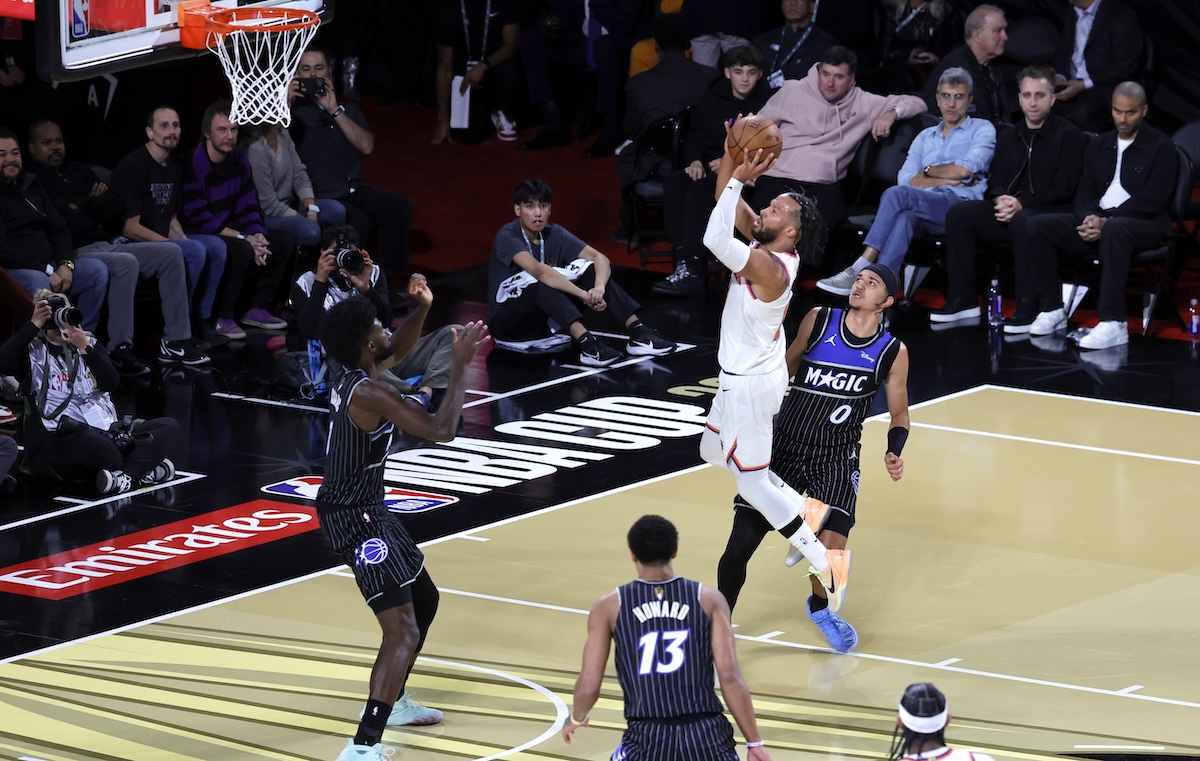
"Why do you think so many NBA players’ sons are making it?" he asked.
"And you’re seeing more and more of that because NBA players are looking at the way basketball is being taught and they’re like, “{Expletive} that.” No.
"How many players do you see whose parents played the game? It doesn’t even have to be Division I. It doesn’t even have to be professional. It’s because they’re seeing how this is being taught, and they recognise quickly, like, 'no' — we have experience in this. We know how this needs to be taught.
"So those kids get this double advantage. I know how to train you. I know how to teach you the game. Because what you’re being taught at the AAU level is not it.
"That’s why they say the worst parents at kids’ sports are the ones that never played sports. The ones who played Division I, Division II, any level — those parents are usually the calmest, the most chill.
"But those parents who played know how to teach the proper steps versus, 'I want my kid shooting threes at eight years old', with crazy form.
"I told Little Rich (his son), do not shoot threes. I don’t care if you’re at the park with your friends — do not shoot threes.
"Now he’s 10, and now he can shoot threes, and his form looks proper.
"And now I can tell his younger brother, who’s eight, 'Do you see how your brother wasn’t shooting threes at eight?' You’re not strong enough. You shouldn’t be doing that.
"There’s a proper progression. Smaller basketballs, bigger ones as you get older, so kids aren’t launching the ball just to reach the rim.
"So much is lost in, 'We’re gonna do dribbling drills and teach full-court press at nine years old'. I took my kids out of that once I saw they spent an hour of practice full-court pressing and learning how to break a press — something that’s irrelevant by the time you're 14.
"Why are you spending time doing that? So you can say you went 42–9 last summer? It’s {expletive} insane. It’s the worst part of basketball I’ve ever seen in my life.
"It’s disgusting."
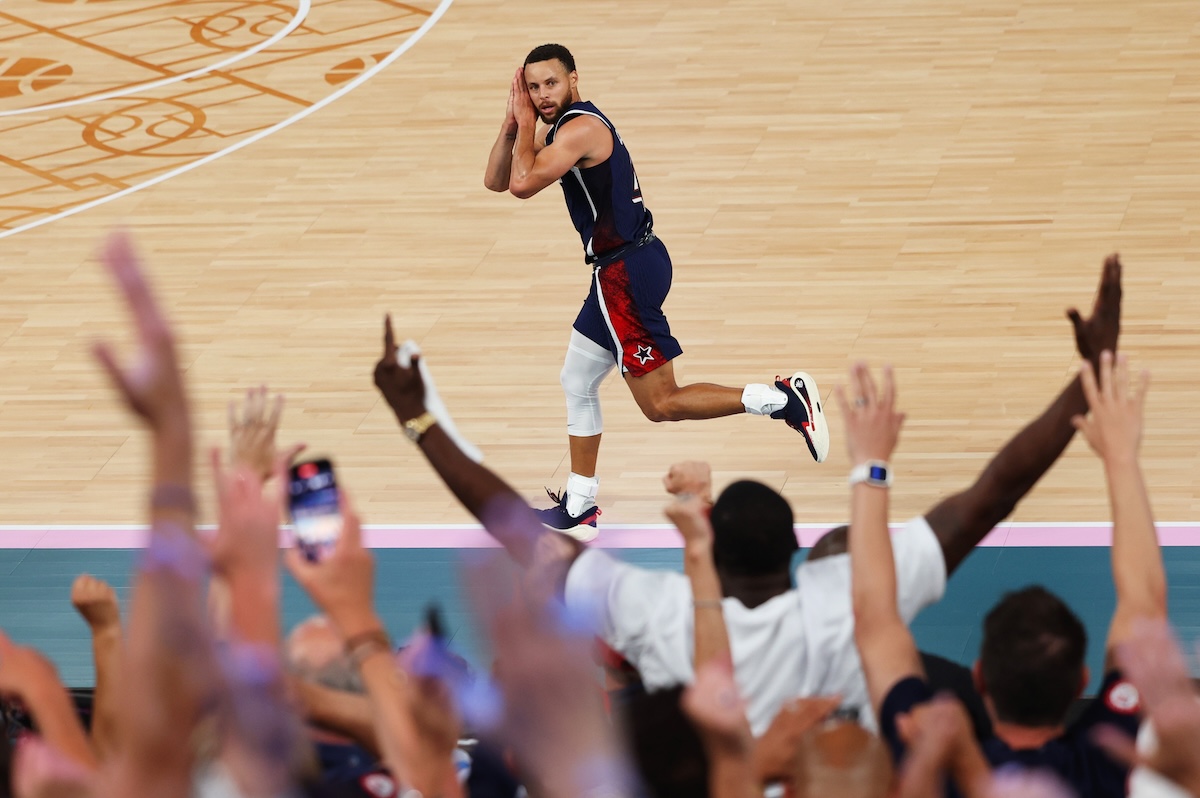
The reality Basketball US now faces is: The world is catching up in both men's and women's basketball with only Curry's heroics at the 2024 Olympic Games in Paris, France, saving the now 17-time gold medallists from a historic defeat. The US women's team escaped with gold by a solitary point 67-66 against host nation France while the men's team held off France 98-87.
Basketball USA has a challenge now. The world is catching and the infrastructure to develop the next generation of American basketballers is broken.
"Three things I try to tell parents," Jefferson said.
"We talk to NBA head coaches, assistants, GMs, college coaches, high school coaches — everybody. The NBA timeline is simple: get as good as you can every single day.
"But now parents pay for trainers, and trainers promise Division I. Then the kid doesn’t grow, or develops late, makes JV as a freshman and sophomore, and mentally thinks, 'I failed'.
"Development isn’t where you are — it’s how you approach every day.
"We’re at eighth-grade tournaments and parents think coaches are watching. College coaches don’t have the budget to recruit eighth graders. Unless you’re top 50, maybe top 75, nobody’s coming. No one cares in eighth grade. Or ninth. Or tenth.
"Be patient with your kids. Teach them the complete game.
"Overseas, they teach you how to move without the ball. I watch these kids work out — they dribble the entire time. Then they get in games and don’t know spacing, don’t know how to sprint the floor, don’t know how to set a screen.
"You know what’s the best thing right now? Three-on-three. It’s the best basketball. Everyone learns to pass. Three-on-three everywhere.
"I did NBA Jam in Phoenix in ’94 — All-Star Weekend — three-on-three in the convention centre. Everybody played.
"Three-on-three teaches you to move without the ball. Pass and cut. We used to make up our own plays. Give-and-go.
"Basketball is being taught so wrong in America.
"One dad asked me how I stay so calm at (his kids') games. Because nobody’s losing a job. Nobody’s gaining a scholarship. Nobody’s here watching except the parents.
"The only thing I ask my son after the game is, 'did you have fun?' I don’t care if you won. 'Did you have fun?'
"That’s it."
What is AAU Basketball
The Amateur Athletic Union (AAU) is a non-profit organisation founded in 1888 to promote amateur sports. Over time, “AAU basketball” has become shorthand for club-based, travel basketball played outside the school system.
How AAU Basketball Works
- Club teams, not schools – Players join independent clubs, often by try-out or invitation.
- Spring–summer season – Typically runs March to August, alongside or after school basketball.
- Tournament-heavy – Teams play multiple games in a weekend, often across state lines.
- Age-group based – Usually U10 through U17.
- Pay-to-play – Families often cover fees for coaching, travel, uniforms, and tournaments.
Why It Became So Influential
AAU exploded in prominence from the 1990s onward because it:
- Became the primary scouting pathway for NCAA coaches.
- Offered national exposure through major circuits (Nike EYBL, Adidas 3SSB, Under Armour).
- Allowed elite players to compete against top peers year-round.
Many NBA players came through AAU, including LeBron James, Kevin Durant, Stephen Curry, and Kobe Bryant.
The Main Criticisms (and why it’s debated now)
AAU is increasingly criticised — including by former NBA players and coaches — for:
- Over-emphasis on games over development: Limited practice time; lots of games.
- Early specialisation & burnout: Kids playing year-round with little rest.
- Individual exposure rather than team concepts: Isolation play, highlight culture.
- Inconsistent coaching standards: Anyone can start a club; quality varies widely.
This is often contrasted with Australian development models, which emphasise:
- Daily skill work
- Teaching spacing, decision-making, and fundamentals
- Fewer games, more training