
4
Dec
In-depth Analysis
Spurs emerge as 'fairytale' ending for FIBA Patty

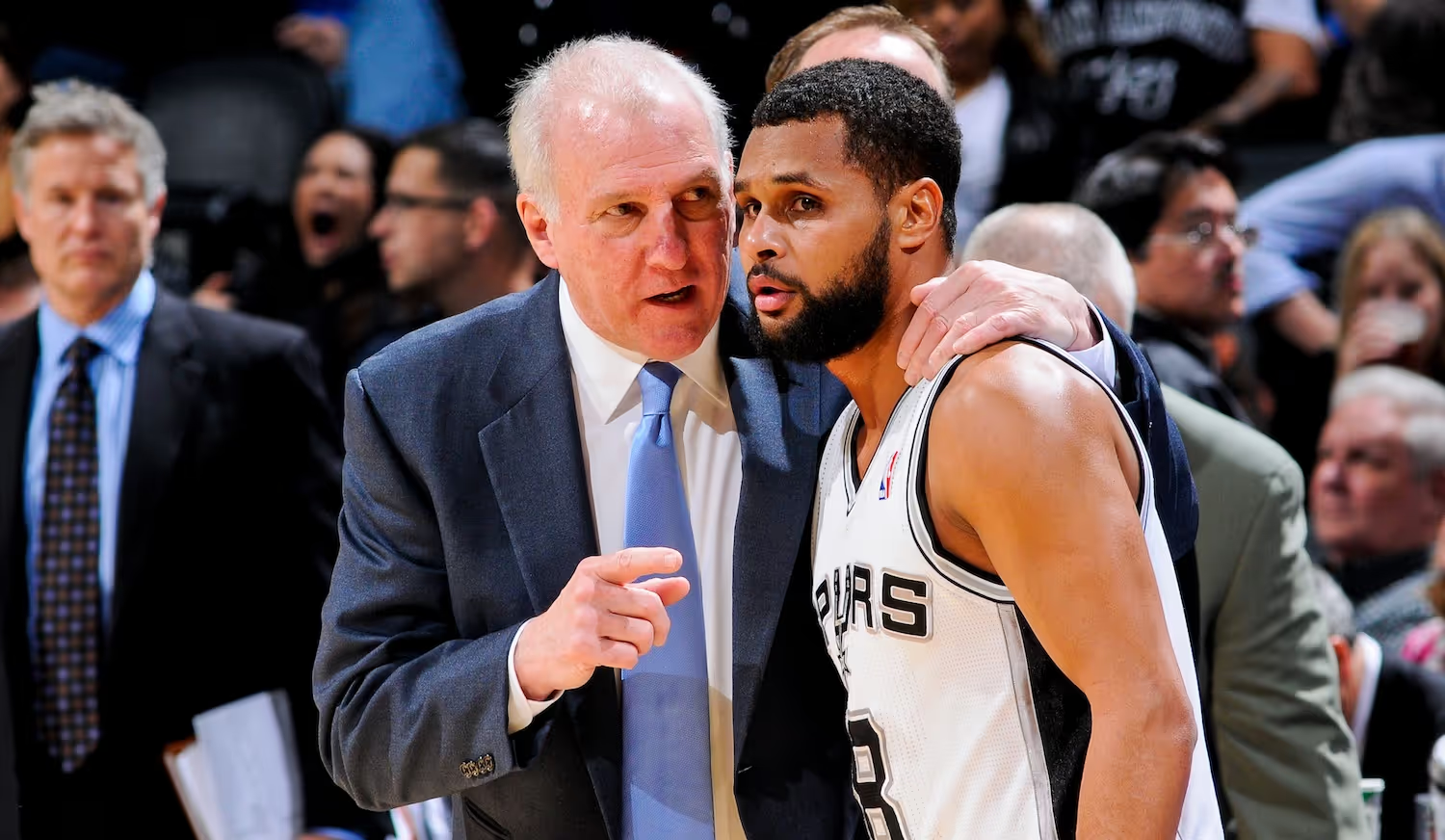
Then head Coach Gregg Popovich of the San Antonio Spurs speaks to Australian guard Patty Mills #8 during a game against the Houston Rockets on December 29, 2012 (AEDT) at the AT&T Center in San Antonio, Texas. Photos: D. Clarke Evans/NBAE via Getty Images
Highlights
Where FIBA Patty Mills fits next: San Antonio Spurs fairytale or perfect-system contender?
- Patty Mills adds new title: GM at Hawaii
- Patty Mills' magical Gregg Popovich moment
- Was Patty Mills’ 42 the best Boomers game ever?
"FIBA Patty" Mills is on island time right now, an unsigned and unrestricted free agent with the first eight weeks of the 2025-26 NBA season now in the rear view mirror.
Much of the focus has been on where fellow Australian Ben Simmons would end up but Mills, 37, is staying ready as videos he posts to his social platforms continue to show while he's in Hawai'i working as the general manager of the University of Hawai'i men's basketball team.
Mills won an NBA championship with the San Antonio Spurs in 2014 and if romance isn't dead, his scouting report and the Texas franchise's need for a veteran shooting point guard could very well mean the Canberra-born Olympic Games bronze medallist could just end up finishing his career at the Spurs.
That would be the fairytale! basketball.com.au has analysed the potential landing spots for Mills for potentially his last ride before retirement and the Spurs are right at the top of the list not just for nostalgia but basketball fit.
Over to you Pop.
Patty Mills’ Contract Status
- Signed 1 year, $3,303,771 with Utah Jazz in 2024–25
- Signed Using: Minimum Exception
- Cap hit 2024–25: $2,087,519
- NOT a buyout
- NOT earning above the Non-Taxpayer MLE
- Is an UFA in 2025–26
What restrictions apply?
Patty Mills CAN be signed by:
- Any team below the cap
- Any team over the cap but under the 1st apron
- Any team over the 1st apron
- Any team over the 2nd apron
Why? Mills can be signed using the Minimum Salary Exception, which is allowed regardless of apron status. He can sign with all 30 NBA teams under the CBA.
Patty Mills Scouting Report
- Name: Patty Mills (Patrick Sammie Mills)
- Position: Point Guard / Shooting Guard
- Height / Weight: 6'2" (188cm), 180lb (81kg)
- Born: August 11, 1988 – Canberra, Australia
- College: Saint Mary’s
- Career: 16 NBA seasons, 1020 games (including playoffs).
Career averages: 8.7 PTS │ 1.6 REB │ 2.2 AST │ 42.3 FG% │ 38.5 3P% │ 85.7 FT% │ 53.8 eFG%
Accolades:
- 2014 NBA Champion (San Antonio)
- 2021–22 NBA Sportsmanship Award
- Long-time Boomers leader and culture piece
Physical / Athletic Profile
- Size: Undersized combo guard at true 6'2", average length, smaller by modern 2-guard standards.
- Athleticism:
- Prime: good straight-line speed, burst, and stamina.
- Now: still in shape and moves well, but more craft than burst. Doesn’t consistently turn the corner against top athletes anymore.
- Durability: 16-year career, often available, but at 37 he’s firmly in “managed minutes / low-usage” territory.
Impact: You’re not signing Patty for physical tools or switchability. You’re signing him for decision-making, shooting gravity and professionalism.
Offensive Profile
1. Shooting
This is still his calling card.
- Career 3P: 38.5% on 4.4 attempts per game – that’s real volume and efficiency.
- Best years (Spurs/Nets):
- Multiple seasons at or near 40% from three on 5–7 attempts.
- 2013–20 range: consistent movement shooter, elite off-the-bench spacer.
- Recent years: efficiency has tailed off (age, role fluctuation, smaller minutes, streakier nights), but the mechanics and willingness are intact.
Shot profile:
- Deep range; comfortable 1–2 steps behind the line.
- Very good catch-and-shoot; can get into shot quickly off relocations, pin-downs, and flare screens.
- Can hit pull-up threes vs drop if defenders go under.
- Comfortable shooting out of handoffs, Spain actions, and flare screens.
Translation now: He’s no longer a microwave 18–20 PPG guy off the bench, but as a 10–15 MPG guard he can still punish teams that over-help or go under screens.
2. On-Ball Creation / Playmaking
Prime Spurs Patty: combo guard who could run 2nd units, push pace, and make simple reads.
Today's Patty: secondary handler, not a primary big-minutes organiser.
- Passing:
- Sees basic PnR reads (pocket pass, hit the roller, skip vs low man).
- Solid in early offense: quick hit-aheads, advance passes, swing-swing.
- Not a manipulator – he’s not bending the defense like a high-usage pick-and-roll star.
- Handle:
- Tight enough to operate PnR and bring the ball up under pressure.
- Uses change of pace and angles more than athletic blow-bys now.
- Doesn’t consistently create deep paint touches against set defenders.
- Role fit:
He’s best as a secondary decision-maker:
Run the offense on bench units with one other creator.
Keep the ball moving, keep the structure, and finish possessions with open threes.
You do not want him as your full-time starting PG at this age.
3. Scoring Inside the Arc
- Historically, very efficient as a two-point scorer for his size (career 47.9% on 2s) because he picks his spots:
- Attacks closeouts.
- Uses quick floaters and short pull-ups.
- Good at exploiting tilted defenses.
- Now, the rim pressure is limited:
- Smaller guard without elite burst = finishes more as a counter, not as a primary weapon.
- You can’t build a drive-heavy system around him.
Bottom line: Inside scoring is a 2nd or 3rd layer – you’re not signing him for rim pressure, you’re signing him to punish rotation mistakes and spacing gaps.
Defensive Profile
At 37, Patty is:
- Undersized vs starting wings
- Average-to-slightly-below as an individual defender now, but:
- Solid stance, competes.
- Understands scheme, positioning, and personnel.
Strengths defensively:
- Competes over screens; won’t die on contact.
- Good communicator – can call coverages, direct younger guards.
- Years in Spurs/Nets systems mean he knows how to execute a scheme, not freelance.
Limitations:
- Can be targeted by big, physical guards/wings in switches.
- Lateral quickness has naturally declined.
- You don’t want him defending 1-on-1 in space vs elite isolation players.
Best use defensively:
- Guard smaller guards or low-usage wings.
- Keep him in structured coverages (chase over, ICE side pick-and-rolls, weak vs strong rules).
- Hide him next to at least one plus wing defender and a reliable rim protector.
Intangibles / Leadership / Culture
This is arguably where you now get most of the value:
- High-character vet: widely respected in locker rooms, staff, and media.
- Championship experience: key rotation guard on the 2014 Spurs; comfortable in big moments.
- Professionalism:
- Prepared, in shape, team-first.
- Comfortable when role shrinks (DNPs, spot minutes) without getting poisonous.
- Mentorship:
- Ideal for young guards and international players.
- Fits as a “second assistant coach in uniform” type on young or playoff-chasing teams.
For a franchise trying to raise standards, build culture, or stabilise a young room, Mills is A+.
Ideal Role in 2025–26
Contract level: Vet minimum / one-year deal
Minutes: 10–15 MPG, depending on health and roster depth
Usage: Low-to-medium; 3–6 shots per game, mainly from three
Offensive role:
- Bench guard who:
- Spaces the floor.
- Can run simple PnR and second-unit sets.
- Allows star guards to play off-ball for stretches.
- Keeps the turnover count low.
Defensive role:
- Guard the least threatening perimeter creator in lineups.
- Provide positional and scheme discipline, not raw stopping power.
- Mentor young defenders on coverages and habits.
Red Flags / Risk Factors
- Age 37:
- Any remaining erosion in lateral movement and stamina could push him into “break glass only” status.
- Declining percentages:
- Past few seasons show more variance; he’s no longer a guaranteed 40% sniper.
- In small roles, a cold shooting month can look worse because the volume is lower.
- Size/athleticism:
- If the team can’t protect him defensively (no rim protection, no strong wings), his weaknesses are exposed more than his strengths.
Summary – What You’re Actually Getting
Patty Mills today is:
- A veteran backup guard whose primary value is:
- Shooting gravity (even if % is slightly down, defenses respect him).
- Decision-making and structure in bench units.
- Locker room leadership and culture setting.
- He is not:
- A full-time starter.
- A primary creator who solves your “we don’t have a lead guard” problem.
- A defensive stopper.
The best landing spot for him is a team that:
- Already has its main engines (primary creator + secondary),
- Needs a trustworthy third guard,
- Values culture, IQ and shooting more than raw athletic upside.
So, where Does Patty Mills Fit?
Since all 30 teams can sign him, we can evaluate pure basketball fit:
Tier 1 — Strongest Fits
1. Phoenix Suns: By the numbers
They do not need a high-usage guard: Booker (6.7 AST) + Gillespie (5.0 AST) + Allen (4.2 AST) is plenty.
They do need:
- A veteran third guard
- A low-mistake ball mover
- A playoff-ready grown-up
- A spacing threat next to Booker and O’Neale
- Stability on bench units when Gillespie or Allen sits
That is exactly Patty Mills’ lane at this point in his career.
Suns’ characteristics
- High-efficiency scoring from Booker/Allen
- Heavy minutes from O’Neale/Brooks on the wing
- A legit vertical/rim presence (Mark Williams)
- Bench offense is inconsistent
- 3rd/4th guard play dips significantly
Patty fits because:
- He won’t take shots away from stars
- He improves spacing for Booker in two-guard sets
- He can share or stagger with Gillespie
- He provides continuity on nights Allen or Gillespie struggle
- He is extremely adaptable: off ball, spot-up, secondary PnR, transition organising
Patty Mills is an excellent fit for this Suns roster:
- The Suns have top-heavy guard minutes (Booker/Allen/Gillespie).
- Bench guard production drops off sharply (Goodwin/Bouyea/Livers).
- They need a low-usage, smart, playoff veteran who can:
- keep pace steady
- space the floor
- protect possessions
- execute the system
- be trusted in clutch rotations
- hold the guard room together
- Mills gives them exactly that, at the minimum, without disrupting roles.
2. Utah Jazz: By the Numbers

This is the environment where a 37-year-old Patty Mills is most valuable. It would mean a return to the Jazz though.
Keyonte George (34.1 MPG, 22.8 PTS, 6.9 AST): He is the point guard of the franchise. He plays star-level minutes and handles everything offensively.
Jazz need someone who can:
- lighten his creation load
- settle 2nd units
- hit catch-and-shoot threes
- not compete for ball dominance
- bring professionalism and structure
Patty fits every one of those.
What Utah lacks:
- A calming veteran
- A minimum-salary guard with shooting gravity
- A bench organiser
- A leader for a very young roster
- Someone to stabilise non-Keyonte minutes
- Someone the coaching staff can trust late-game
- A voice who has seen every defensive coverage in existence
What Patty brings:
- 38.5% career from 3
- Instant fit in any offense
- Plays without needing touches
- Championship experience
- Locker-room leadership
- Can play 10–16 minutes
- Can run the team if Keyonte is out
- Can mentor Collier and Clayton
- A “stability veteran” that Utah does not have
Line-ups with Patty are a great fit
- Patty / Keyonte / Lauri / Kessler / Nurkić
- Patty / Svi / Bailey / Lauri / Nurkić
- Patty / Collier / Sensabaugh / Hendricks / Filipowski
- Patty / Clayton / Cody Williams / Hendricks / Kessler
3. New Orleans Pelicans: By the Numbers
New Orleans does not have a true veteran point guard on the roster.
And their two lead guard creators are:
Jeremiah Fears — 19-year-old rookie PG
- Promising
- Dynamic scorer
- But a 1.2 AST/TO ratio = dangerous for a playoff team
- Not capable of organising a playoff offense
- Needs a veteran mentor
Jordan Poole — chaos engine
- 17.3 points
- 3.4 assists
- 2.1 turnovers
- Shot selection is unpredictable
- Best as a scoring 6th man, not a system organiser
No other guard is a primary playmaker. This is where Patty helps.
Their entire team depends on Zion + Trey Murphy III creating driving lanes.
To maximise this:
- They need shooters
- They need low-turnover guards
- They need spacing around Zion
- They need someone who can feed Derik Queen in the post
- They need someone who can get them into sets without drama
- They need a grown-up for the young guard core
This is EXACTLY a Patty Mills skillset.
Responsibilities:
- Run 2nd-unit offense
- Space the floor for Zion and Murphy
- Take PG minutes from Poole
- Mentor Jeremiah Fears
- Settle the team late in halves
- Provide a playoff-ready option at guard
- Replace low-IQ possessions with stabilising ones
- Add championship experience to a young locker room
Lineups that would work well:
- Patty / Murphy / Herb Jones / Zion / Queen
- Patty / Poole / Murphy / Bey / Matković
- Patty / Alvarado / Hawkins / Zion / Looney
- Patty / Fears / Murphy / Jones / Queen
Mills is a very strong fit for the Pelicans.
4. San Antonio Spurs: By the Numbers
1. De’Aaron Fox — 33.3 MPG, 24.5 PTS, 6.4 AST
- Elite.
- Ball-dominant.
- Plays huge minutes.
- The offensive engine.
NO ONE is taking minutes from him.
Patty = backup only.
2. Stephon Castle — 32.0 MPG, 17.3 PTS, 7.5 AST
This is crucial: Castle is averaging 7.5 assists, the highest on the team.
Meaning:
- He is already Fox’s co-creator
- He defends at a high level
- He is huge for a guard
- He handles secondary playmaking
- He plays 30+ minutes
This means: The Spurs do NOT need another big-minute creator; and they need a small-minute stabiliser.
3. Dylan Harper — 21.2 MPG, 13.4 PTS, 3.4 AST
Huge scoring upside. But:
- Rookie mistakes
- High turnover rate
- Still learning NBA reads
- Not a floor general
- More combo than PG
The Spurs need a veteran adult behind him. This is where Patty fits.
4. Jordan McLaughlin — 9.3 MPG, 3.5 PTS, 1.3 AST
He is the exact archetype Patty competes with. BUT:
- He is not producing
- He is injured
- Even when he’s healthy, he does not bring playoff experience
- He is not the locker-room voice Patty is
- He does not shoot as well as Patty
He is NOT a blocker for Patty.
The Spurs need:
- A vet stabiliser: Because Fox + Castle + Harper are all high-usage, on-ball, young or explosive guards.
- A shooter: Spurs are 26th in team 3PT%. Patty’s 38.5% career solves a real need.
- A mistake-free bench guard. The Spurs have huge turnover issues: Patty = low turnover, high IQ.
- A mentor: Castle + Harper + Castle/Wemby era = very young team.
Pop LOVED Patty for exactly this reason.
- Someone who doesn’t need on-ball reps: Fox + Castle handle the creation.
Patty = perfect off-ball spacer on 2nd units.
Current PG rotation:
- De’Aaron Fox — 33 MPG
- Dylan Harper — 21 MPG
- Jordan McLaughlin — 9 MPG (injured and ineffective)
- David Jones Garcia — deep bench
SHG rotation:
- Stephon Castle — 32 MPG
- Julian Champagnie — minutes depend on injuries
- Lindy Waters III — situational
There is a clear need for a real 3rd guard who:
- Can play 8–14 minutes
- Doesn’t take the ball from Fox/Castle
- Provides shooting around Wemby
- Can calm bench units
- Has championship experience
That is Patty Mills. Patty would immediately: replace Jordan McLaughlin in the rotation and be a:
- 10–14 minute third guard
- “stabilise the offense for 8 possessions” guy
- Castle/Harper mentor
- late-game safety valve shooter
- culture-setter in a young locker room
- Wemby spacer in specific lineups
Gregg Popovich loves Patty! The Spurs are an absolute fit for FIBA Patty
Best destinations for basketball purposes:
- Phoenix Suns
- Utah Jazz
- New Orleans Pelicans
- San Antonio Spurs
Doesn’t Make Basketball Sense
- Cleveland Cavaliers (too guard-heavy)
- Golden State Warriors (unless someone is traded)
- New York Knicks
- Boston Celtics
- Dallas Mavericks
- Minnesota Timberwolves
These teams are allowed to sign him — they simply don’t have available rotation minutes.