
19
Jul
Aussies in the NBA
Roc’s stock and a smoking barrel: Zikarsky adds three-ball

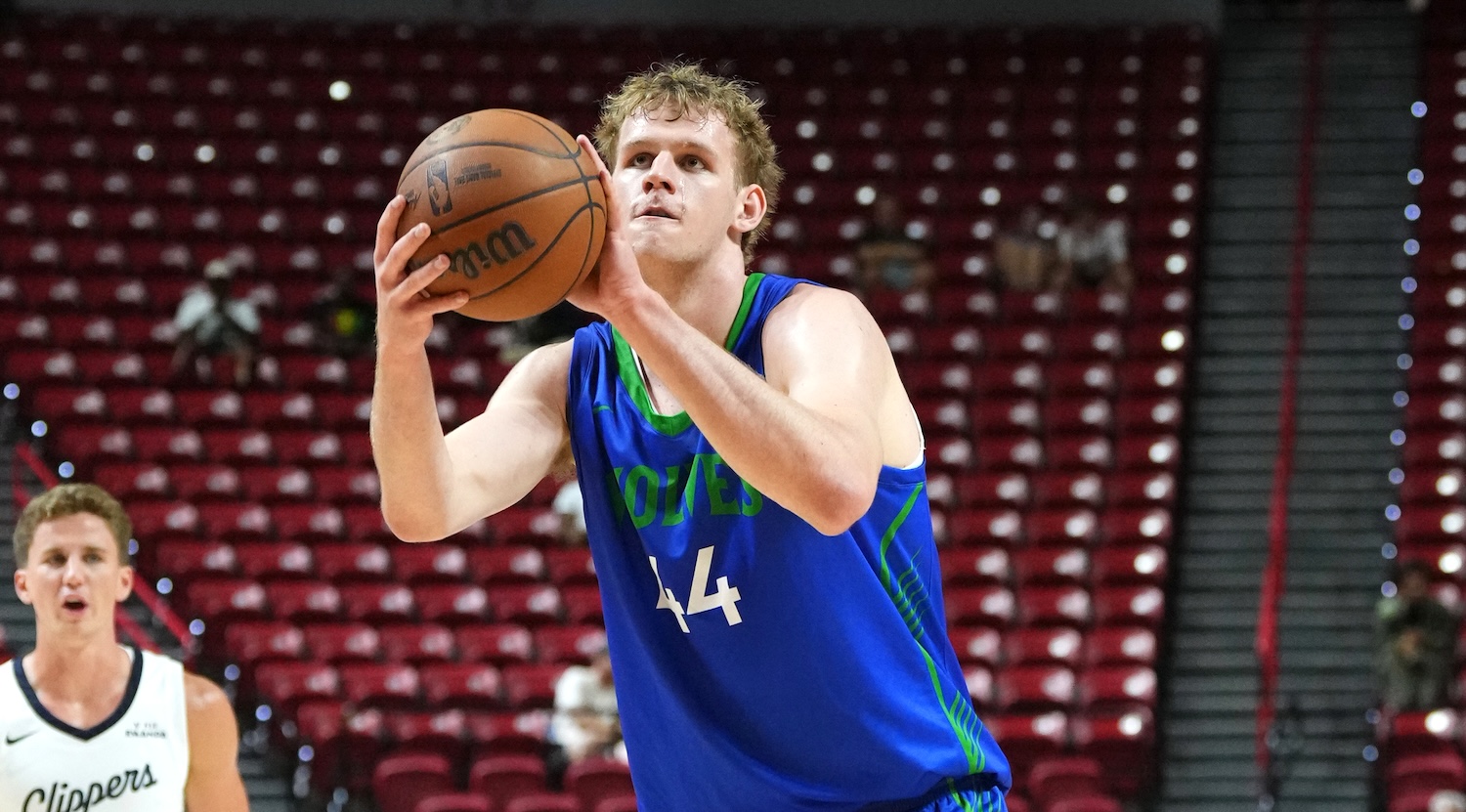
Minnesota Timberwolves centre Rocco Zikarsky attempts a free throw against the LA Clippers during the 2026 NBA Summer League at the Thomas & Mack Center in Las Vegas. The Australian seven-footer averaged 12.2 points, 5.8 rebounds and 1.8 blocks across five Summer League games as he continued his push towards a regular NBA role and Boomers selection. Photo: Candice Ward/NBAE via Getty Images.
Highlights
Rocco Zikarsky's expanding range is accelerating his NBA rise and Boomers 2027 World Cup push.
- 19-year-old Rocco Zikarsky is an NBA player
- All-Star Rocco Zikarsky gets his 2026 'LA Story'
- Rocco Zikarsky follows in Aussie giant's footsteps
Queenslander Rocco Zikarsky has reached the point where development alone is no longer the story.
After producing across the G League last season, flashing genuine NBA-level rim protection and finishing the 2026 Summer League with three double-figure scoring games, the next phase is about turning promise into dependable minutes – first for Minnesota and then, potentially, for the Australian Boomers at the 2027 FIBA World Cup.
"My confidence levels are at a whole different level now," Zikarsky said last week in Las Vegas.
"Just knowing the system, being around the team for a longer period of time, you build trust and compatibility with the coaches.
"Physically, my wind is a lot better than it was last year. I'm stronger and I can move better as well."
One of the more intriguing developments was Minnesota's willingness to let Zikarsky play beyond the arc. The 221cm centre attempted 14 three-pointers in five Summer League games this month after averaging 2.8 attempts per game in the G League.
While the percentages – 21.4% in Summer League and 25.6% in the G League – remain a work in progress, the willingness to shoot represents a significant evolution in his game. A year ago, Zikarsky was viewed almost exclusively as a rim-running, shot-blocking centre.
Today, the Timberwolves are clearly investing in developing him into a modern NBA big capable of stretching the floor.
"One of my biggest focuses is rebounding and extra-effort plays," he added.
"Those hustle plays make the whole team better. I also want to showcase that I can space the floor and play alongside a special talent like Joan (Beringer).
The former NBL Next Star Zikarsky only just turned 20 and has played just 37 NBA minutes last season, but his body of work is beginning to form a compelling selection case.
He averaged 15.8 points, 9.9 rebounds and 2.7 blocks in 27.4 minutes across 28 games for the Iowa Wolves, shooting 53.4% from the field and 79% from the free-throw line.
He then added 12.2 points, 5.8 rebounds and 1.8 blocks per game at Summer League, finishing with 61 points, 29 rebounds and nine blocks across five appearances.
His NBA sample was minuscule, but productive. Zikarsky had 14 points, 14 rebounds and five blocks in 37 minutes, including eight points, nine rebounds, two assists and two blocks in 20 minutes against New Orleans in the final game of the regular season.
Those numbers do not guarantee a spot in either Minnesota’s rotation or Australia’s World Cup squad.
They do, however, place him firmly in the conversation.
The immediate challenge in Minnesota
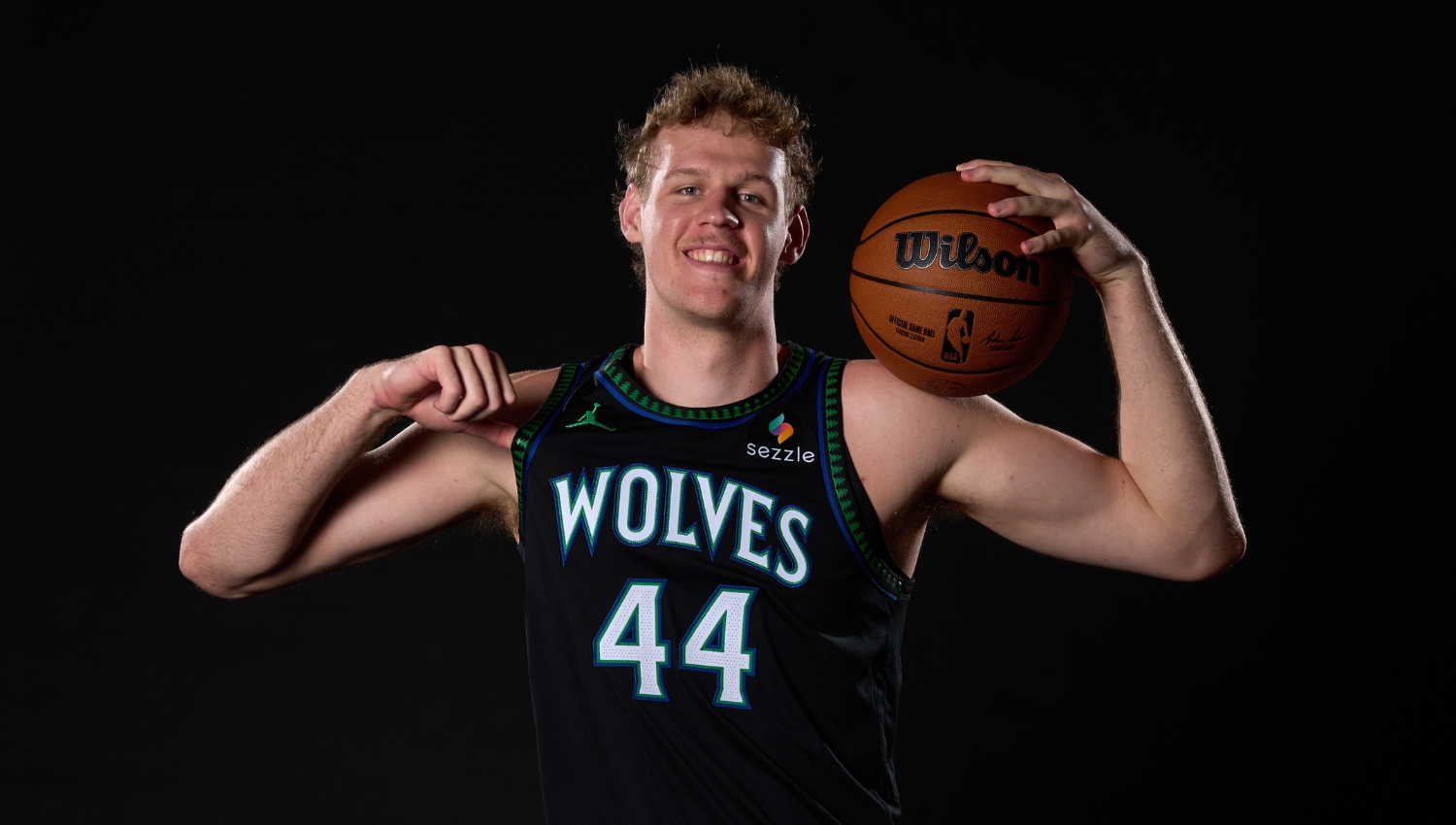
Zikarsky enters the 2026-27 season as Minnesota's third-string centre, sitting behind four-time NBA Defensive Player of the Year Rudy Gobert and highly regarded first-round rookie Joan Beringer on the Timberwolves' depth chart.
That's not a bad place for a 20-year-old second-round pick.
Gobert remains the starter on a team with championship aspirations, while Beringer appears to have the inside track on the backup role after being selected 17th overall in this year's draft. That leaves Zikarsky in a familiar position – developing, waiting and preparing for opportunities that inevitably arise over an 82-game season through injuries, rest, foul trouble and roster movement.
Zikarsky said he has been studying film of Gobert.
"I've learned a lot," he said.
"I play a lot of drop coverage, just like Rudy, so watching his film and watching him from the bench has been invaluable.
"His ability to rebound outside his area and even just deter shots is unbelievable. Sometimes players don't even shoot because of his presence.
"Then there's the little things like playing hard and his screen-setting. His screens are elite.
"He's been in the league for a long time and won Defensive Player of the Year so many times, so it's invaluable sharing the floor with him."
Zikarsky's pathway will almost certainly include significant minutes with the Iowa Wolves, but another season in the G League should not be viewed as a setback. The objective is no longer simply putting up numbers. Minnesota needs to see that he can quarterback a defence, communicate coverages, defend the pick-and-roll and consistently finish possessions with rebounds.
Offensively, his role is already well defined.
The Timberwolves don't need Zikarsky to become a featured scorer. They need him to set solid screens, dive hard to the rim, finish efficiently, rebound and make quick decisions with the ball. Those are exactly the traits he displayed as his Summer League progressed, shooting 19-of-28 (67.9%) across his final three games after a slower start.
His outside shooting remains a longer-term project, but it's also one of the more intriguing parts of his development. Zikarsky attempted 2.8 three-pointers per game in the G League and 14 threes across five Summer League games, clear evidence that Minnesota wants him to expand his offensive game beyond the paint.
Whether those shots begin to fall consistently is almost secondary. The important development is that he now has the licence to take them.
If Zikarsky continues protecting the rim, finishing efficiently and gradually adds a dependable perimeter shot, he'll give Chris Finch another dimension off the Timberwolves' bench—and strengthen his case to become part of Australia's frontcourt for the 2027 FIBA World Cup.
Rocco Zikarsky's G League, NBA and 2026 Summer League Numbers
The Boomers opportunity
The 2027 World Cup arrives at an ideal – and challenging – point in Zikarsky’s development.
He will be 21 before the tournament, young enough to be viewed as part of Australia’s future but experienced enough that selection cannot be justified solely as an investment.
Australia’s centre hierarchy still begins with Jock Landale, who remains Australia's most established international big man. Landale is coming off one of the strongest NBA seasons of his career and projects as the Boomers’ starting centre when available.
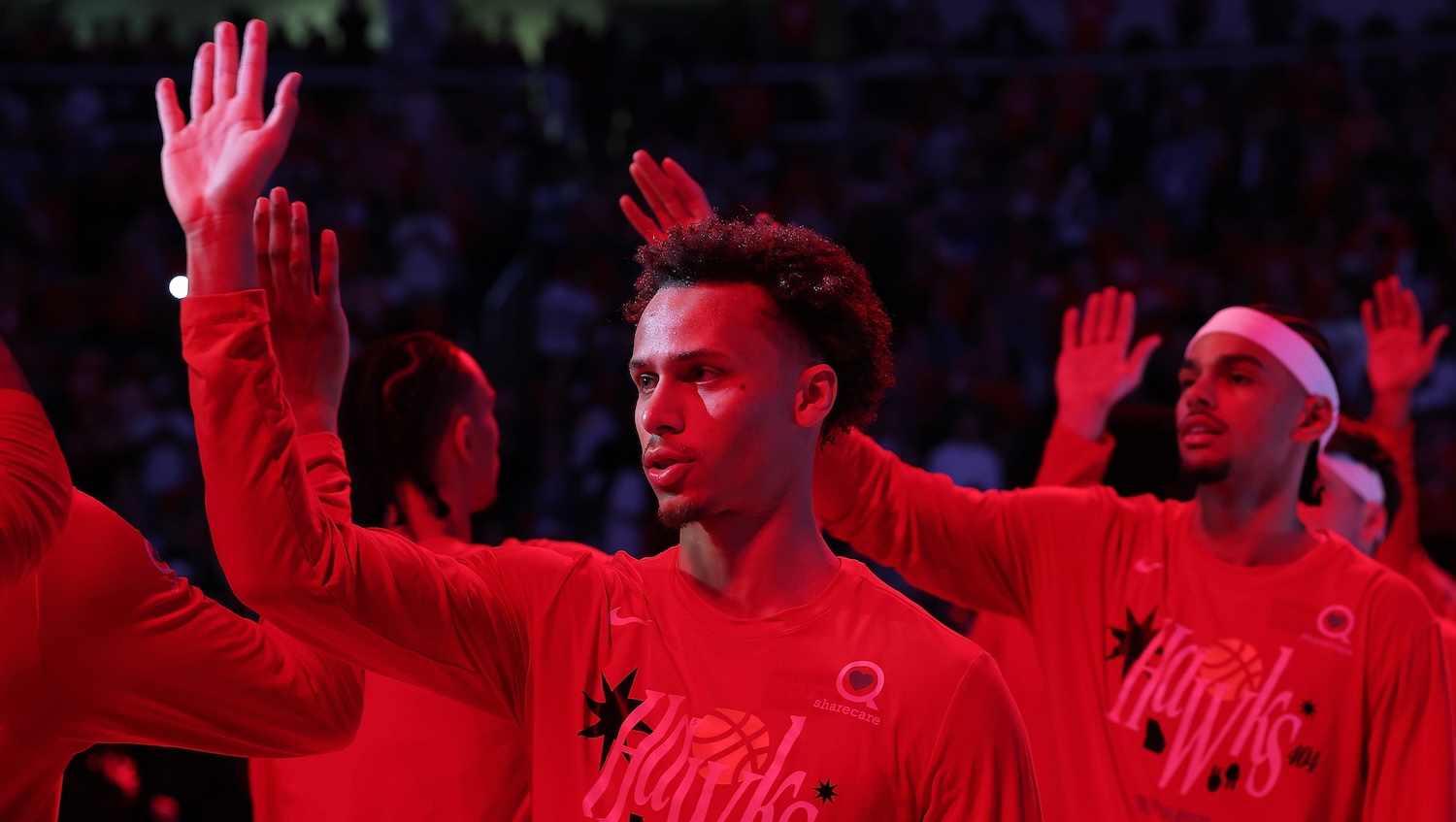
Landale signed his richest single season contract to stay with Dyson Daniels' Atlanta Hawks for the 2026-27 season.
Will Magnay also remains a trusted international option, while Keanu Pinder, Sam Froling, Duop Reath and Alex Condon provide different combinations of mobility, shooting, strength and experience.
basketball.com.au has already identified Landale and Magnay as likely frontcourt anchors, with Zikarsky developing as a long-term Boomers big.
That makes the likely selection battle less about whether Zikarsky is talented enough and more about what type of centre head coach Adam Caporn wants behind Landale.
Zikarsky offers something few Australian big men can match: genuine 221cm size combined with high-level shot-blocking.
That becomes particularly valuable in the World Cup where Australia will encounter elite interior scorers, powerful rolling centres and teams capable of attacking the paint repeatedly as well as pick and pop bigs.
His nine Summer League blocks and 2.7 blocks per game in the G League show that rim protection is not theoretical. It is already his most bankable skill.
What he must prove to Adam Caporn
For Zikarsky to make the final 12, he must prove he can function within a sophisticated international defence. FIBA hoops places enormous pressure on centres. They must defend ball screens, protect the rim, rebound through contact and make rapid reads in crowded spaces.
Zikarsky cannot rely on his height alone. He must show that he can defend without conceding easy pull-up shots, recover after containing the ball-handler and avoid being dragged away from the rim by shooting bigs.
International defensive systems depend on the centre calling coverages early and organising the players in front of him. That is often the final step for young big men moving from prospect to trusted rotation player.
Offensively, Caporn will need confidence that Zikarsky will not clog the floor.
He does not need to run offence through him, but he must set strong screens, roll with force, finish through contact and move the ball quickly. His five-assist game against the Clippers was an encouraging glimpse of his passing instincts, but that must become repeatable rather than exceptional.
Free-throw shooting will also be watched.
His 4-of-14 performance at Summer League was poor, but his 79% return across 28 G League games is the more meaningful sample. If he remains near that level, opponents cannot simply foul him to remove his efficiency around the basket.
The qualification windows matter
Australia’s route to the 2027 World Cup preparations continue through three remaining FIBA windows: August 24 to September 1, November 23 to December 1 and February 22 to March 2, 2027.
Those windows present both an opportunity and a complication.
NBA players are not always available during the regular season, which means qualifying squads often feature NBL players and Australians based in leagues with compatible calendars. Zikarsky’s availability will depend on Minnesota and Iowa, but any opportunity to enter a Boomers camp would be significant.
Even if he is not needed for qualification, being exposed to Caporn’s system before the World Cup selection camp would accelerate his case. National-team coaches value familiarity, particularly from young players competing against veterans with years of accumulated trust.
The current Boomers program has already continued broadening its player pool through the qualifiers, with emerging players such as Tyrese Proctor, Alex Condon, Taran Armstrong and Ben Henshall receiving opportunities around established NBL names.
Zikarsky belongs in that next-generation group.
What would secure his World Cup place?
The clearest path is meaningful NBA rotation minutes.
Should Zikarsky establish himself as Minnesota’s third centre and play regular competitive minutes during the 2026-27 season, his World Cup case becomes difficult to ignore.
Even 10-to-12 NBA minutes per game would expose him to a level of speed, strength and tactical pressure no other competition can reproduce.
If NBA minutes remain scarce, another dominant G League season could still be enough – particularly if he improves his defensive rebounding, foul discipline and pick-and-roll coverage.
His statistical targets do not need to be dramatic. Maintaining approximately 15 points, 10 rebounds and two-plus blocks while reducing turnovers and improving his three-point percentage would show meaningful progression.
The Boomers do not need him to be their leading centre in 2027. They may need him to provide eight aggressive minutes, protect the rim, change the physical tone and give Landale a rest without the defence collapsing.
That is a realistic role.
World Cup projection
Zikarsky should not yet be considered a guaranteed member of Australia’s final 12.
Landale’s place appears secure when healthy, while Magnay’s international experience, mobility and defensive reliability give him an advantage. Condon’s emergence and the versatility of Pinder and Froling further intensify the competition.
But Zikarsky possesses a selection weapon none of those players can exactly replicate. He is 221cm, rebounds above the rim and can erase mistakes at the basket.
That gives Caporn the option of selecting him not merely as a project, but as a situational defensive centre capable of changing matchups.
At this stage, Zikarsky projects as being on the edge of the 2027 squad — somewhere between the final selected centre and the first big man omitted.
The next NBA season will decide which side of that line he lands on.
If he earns regular minutes, defends ball screens competently and carries his G League rim protection into NBA games, he should be in Qatar.
If he remains almost exclusively a developmental player, Australia may choose the certainty of an older, more experienced centre.
The talent is sufficient. The production is building.
What comes next is trust – from Chris Finch in Minnesota, from Caporn with the Boomers and from Zikarsky himself when the level rises.
Zikarsky enters the 2026-27 season exactly where a 20-year-old second-round pick should be: third on Minnesota's depth chart, learning behind four-time Defensive Player of the Year Rudy Gobert while pushing first-round rookie Joan Beringer for backup minutes.
The next step isn't becoming Minnesota's starting centre. It's proving he belongs in the NBA rotation. If he can do that over the next 12 months, the conversation around the 2027 Boomers World Cup squad changes from whether he should be considered to whether Australia can afford to leave its biggest rim protector at home.







.jpg)