
8
Dec
In-Depth Analysis
Stunning stats! Why Daniels is way better than you think

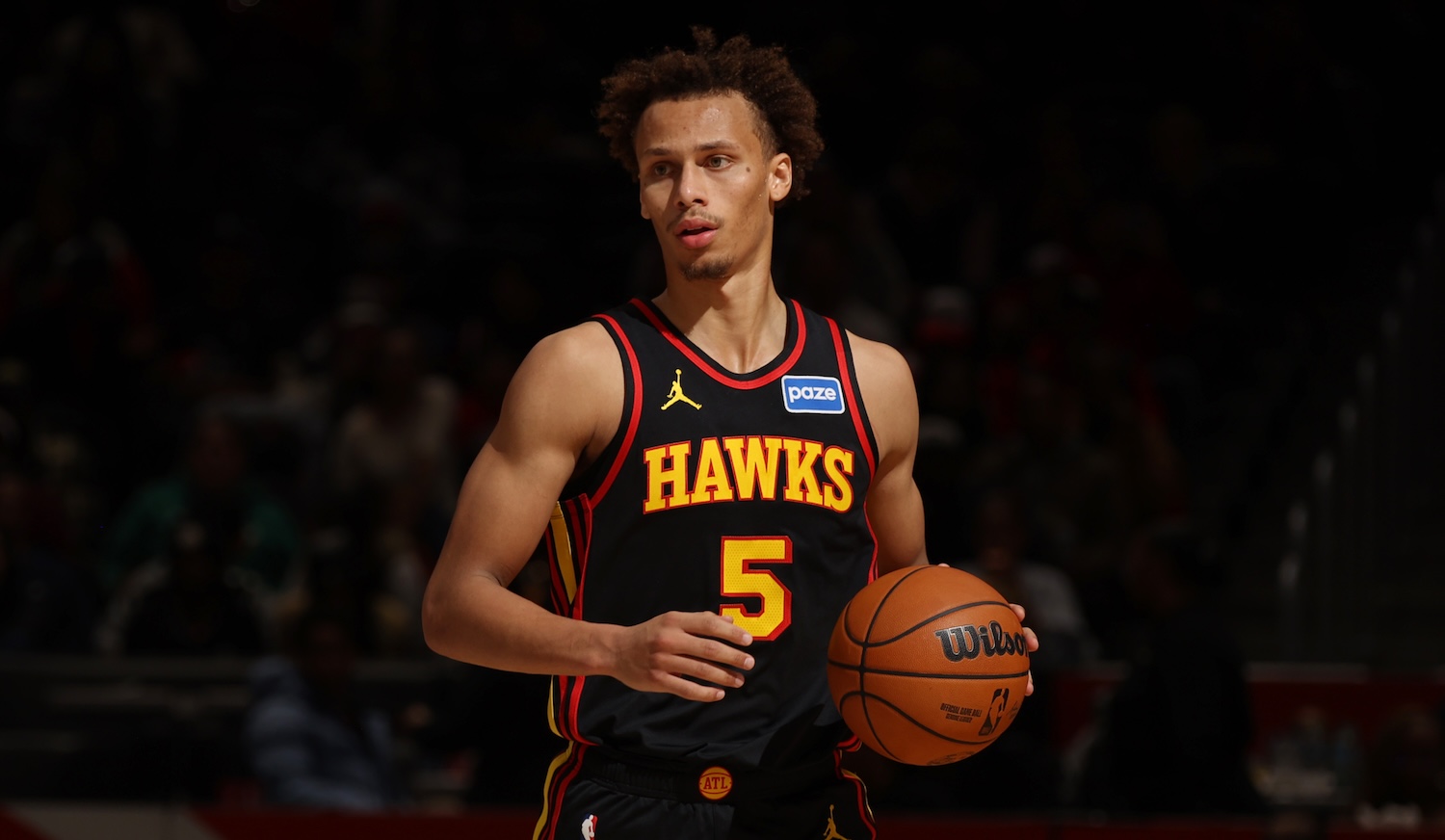
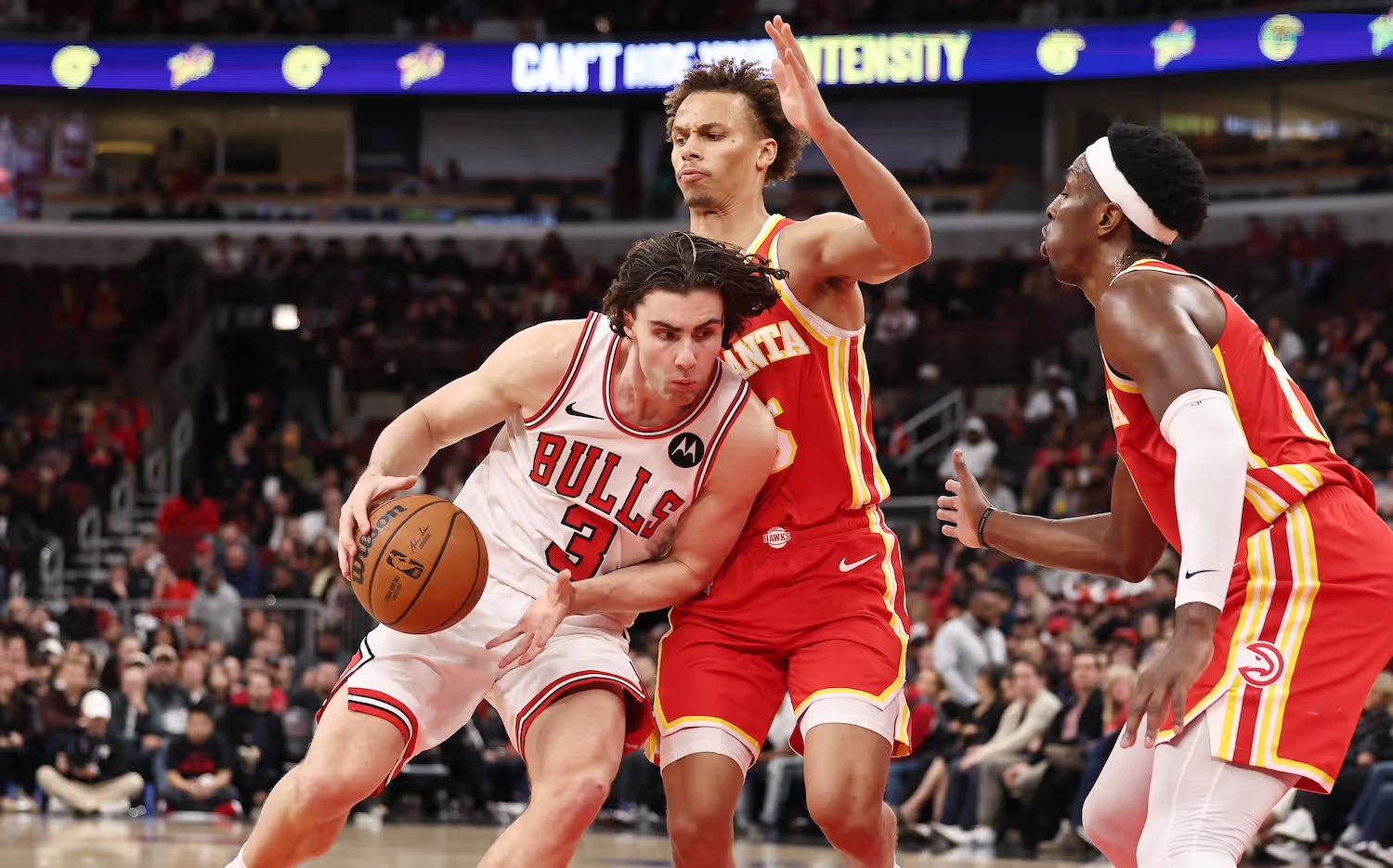
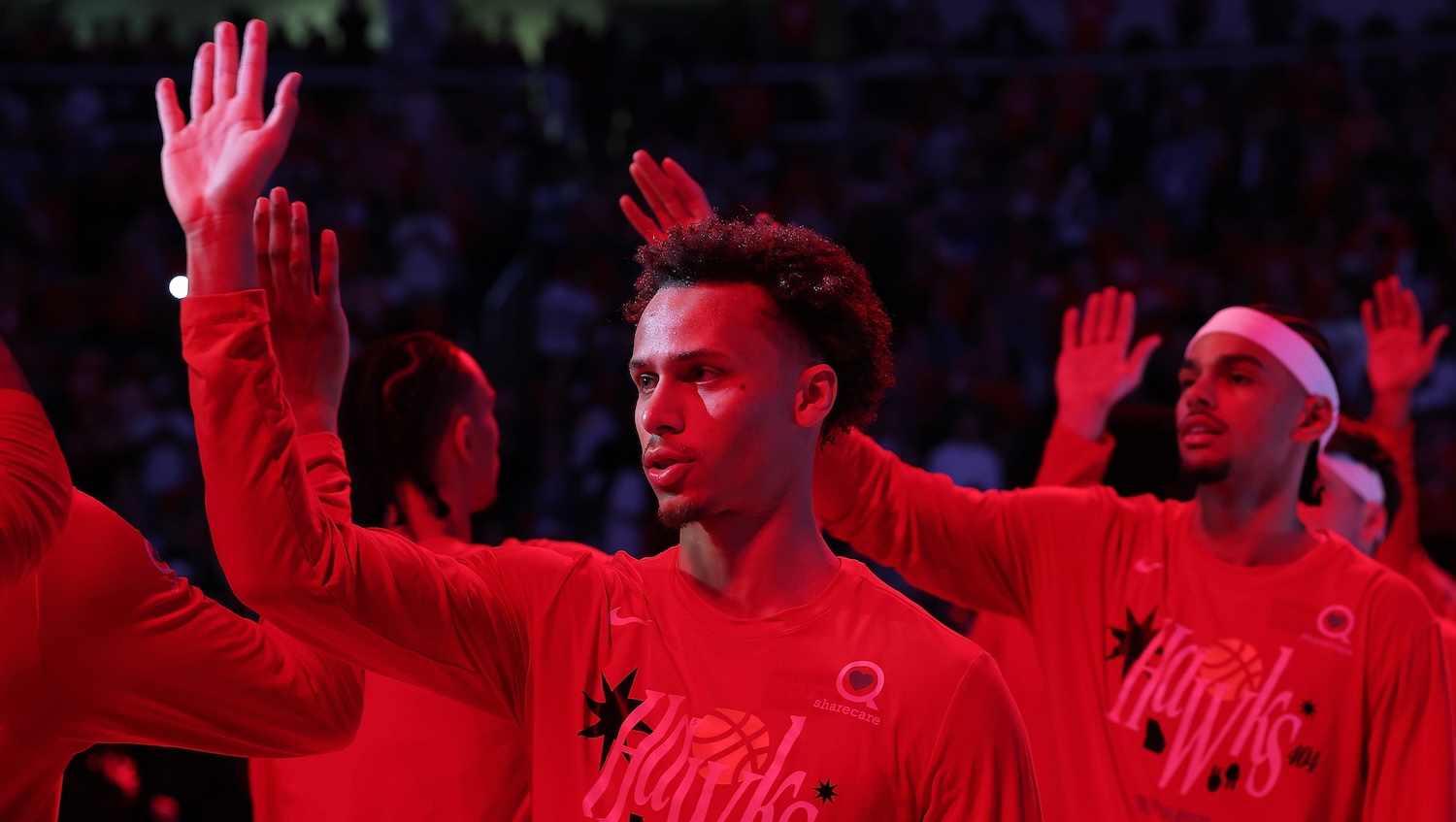
Australian Dyson Daniels #5 of the Atlanta Hawks is having a career year in 2025-26. Photo: Stephen Gosling/NBAE via Getty Images
Highlights
Dyson Daniels is having a career year as an elite defensive, playmaking point guard in Atlanta.
- Daniels’ scoring dip hides a major leap in impact and responsibility for Atlanta.
- Trae Young’s injury pushed Daniels into full-time point guard duties — and he’s thriving.
- LEBRON and guarded data show All-Defense calibre impact at the point of attack.
Australian Dyson Daniels is having a career year. He has evolved into a true two-way point guard for the Atlanta Hawks, which is a rarity in the NBA.
The numbers don't lie.
Skeptics will point to Daniels' drop in scoring from 14.1 points per game last season to 10.1 points per game in the first 25 of the 2025-26 season that his game has regressed.
It's complete and utter nonsense.
Critics of the 22-year-old Daniels' four-year USD $100M contract extension circled the 2024-25 Most Improved Player after his scoring has dropped off through the first month of the season all while defensive numbers haven't decreased while boards and assists have.
Daniels was moved into the point guard spot after Atlanta Hawks superstar Trae Young hurt his knee on November 2, 2025. Since then he has flourished while learning how to be a starting point guard in the NBA, arguably the hardest position in the game.
Daniels is leading the league in steals with 54 (2.3 per game) while running the Hawks offense. He's averaging 10.1 points, a career-high 6.2 rebounds, and career-high 5.8 assists. He has also played the second most minutes of any player in the NBA this season with 849 through 25 games.
But that barely scratches the surface of Daniels' impact in 2025-26. It brings us to bball-index's LEBRON metric and how it reveals the true impact of Daniels' growth this season.
- Luck-adjusted player
- Estimate using a
- Box prior
- Regularised
- ON-off
What is the LEBRON Metric
bball-index.com explains the Metric as: "Put simply, LEBRON evaluates a player’s contributions using the box score (weighted using boxPIPM’s weightings stabilised using Offensive Archetypes) and advanced on/off calculations (using Luck-Adjusted RAPM methodology) for a holistic evaluation of player impact per 100 possessions on-court.
"LEBRON is broken up between LEBRON (overall impact), O-LEBRON (offensive impact), and D-LEBRON (defensive impact). It is a measure of impact, not talent, and like with our talent grades has an age growth curve where we expect players to get better (more rapidly when younger) over time and then drop over time (more rapidly the older they get) later in their career."
So, regression? Seriously. Total rubbish. These are the FIFTEEN categories Daniels' is in above the 90% percentile of all NBA Players.
- Perimeter Isolation Defense — 100
- Matchup Difficulty — 100
- Guarded Midrange Talent — 100
- Guarded Playmaking Talent — 100
- Guarded Shooting Talent — 99
- Guarded Offensive Involvement Rate — 99
- Guarded One-on-One Talent — 97
- Guarded 3PT Shooting Talent — 96
- Multi-Year D-LEBRON — 95
- D-LEBRON — 93
- Offensive Rebounding Talent — 91
- Play Type Versatility — 91
- Creation Volume — 90
- Creation Quality — 94
- Steals per 75 — 99
Full Breakdown Dyson Daniels
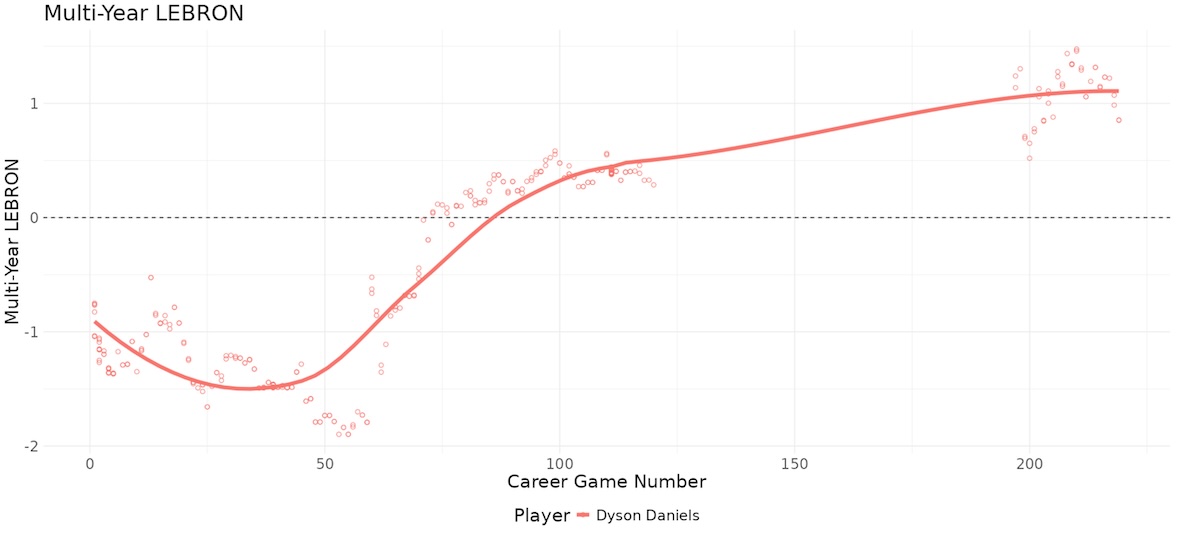
Trend Summary
- Games 0–50: Starts slightly above zero. Already positive defender.
- Games 50–120: Climbs sharply above 1.0, entering near All-Defense territory.
- Games 120–200+: Levels out around 1.3–1.5, elite defensive impact.
Interpretation
Daniels becomes one of the best point-of-attack defenders in the NBA between games 80–150, then sustains it.
Tie to PG role
This gives Atlanta an unusual PG archetype:
- A lead ball-handler who provides elite defensive value: This is extremely rare and lineup-shaping.
.jpg)
Trend Summary
- Games 0–50: Declines into heavy negative territory (-1.8 to -2.1).
- Games 50–120: Bottoms out. Worst offensive stretch.
- Games 120–200+: Significant rise, up to around -0.7 to -0.5.
Interpretation
Daniels’ offense is still a net negative — accurately reflected in shooting/creation grades — but:
- His offensive impact is improving,
- His usage/responsibility is rising,
- He is becoming a stabilising offensive connector.
Tie to PG role
This improvement is what allowed the Hawks to trust him as the primary initiator during Trae’s injury period.
.jpg)
Trend Summary
- Games 0–50: Starts slightly above zero. Already positive defender.
- Games 50–120: Climbs sharply above 1.0, entering near All-Defense territory.
- Games 120–200+: Levels out around 1.3–1.5, elite defensive impact.
Interpretation
Daniels becomes one of the best point-of-attack defenders in the NBA between games 80–150, then sustains it.
Tie to PG role
This gives Atlanta an unusual PG archetype:
- A lead ball-handler who provides elite defensive value. This is extremely rare and lineup-shaping.
.jpg)
Trend Summary
- Games 0–50: Begins around league average (~1.1), defenders respect him modestly.
- Games 50–120: Sharp decline → bottom-out near 0.3, meaning defenders were ignoring him off-ball.
- Games 120–200+: Strong upward climb, recovering back toward 1.8, which is significant positive gravity.
Interpretation
This is the most important offensive trend in his career charting. It shows:
- Early slump in shot confidence + reputation (defenders went under everything).
- Clear improvement in off-ball credibility over time, especially over the last 70–80 games.
Tie to 2025–26 PG role
Even as a point guard, higher off-ball gravity matters because:
- It increases viable spacing when he initiates then relocates.
- It makes Atlanta’s 5-out second-side actions far more functional.
This trend aligns with BBall-Index’s grades showing improved spot-up play and playmaking efficiency.
.jpg)
Trend Summary
- Starts extremely high (mid-40s), rises slightly, then flattens.
- Never drops below 40%, which is insane for a young guard.
Interpretation
Daniels has been assigned primary matchups at a rate comparable to All-Defensive guards from day one.
Tie to PG role
Even with the offensive load increase:
- Defensive load has not been reduced.
- He still guards the opponent’s best perimeter threat.
This combination (lead guard + defensive stopper) is rare and extremely valuable.
.jpg)
Trend Summary
- Games 0–50: Starts around 15–17%.
- Games 50–120: Builds toward ~19–20% (similar to On-Ball Action Share).
- Games 120–160: Falls hard to 10–12%, the lowest of his career.
- Games 160–220+: Dramatic rise back toward 19–20%, then peaking above that in the previous period.
Meaning
This mirrors the previous graph, reinforcing the same developmental arc:
- Early to Semi-featured
- Mid-career off-ball defender/connector role
- Now a central initiator
Tie to 2025–26 PG role
Offensive involvement rate is a macro indicator (cuts, drives, screens, handoffs included).
The sharp rise indicates:
- He’s touching the ball more,
- He’s dictating possessions,
- He’s handling high-leverage offensive responsibilities.
This confirms the Hawks have given him true point guard responsibility, not just “emergency PG minutes.”
.jpg)
Trend Summary
- Starts near –0.5 (defenses go under screens early).
- Drops to –0.8 (worst zone).
- From Game 150 onward: steady climb back toward 0.0.
Meaning
On-ball gravity = how much defenders worry about you when you have the ball.
Daniels going from:
- “Ignore him, go under”
- “Respect him enough to alter coverage”
…is a massive deal for his PG runway.
Tie to PG role
- Higher on-ball gravity
- Better spacing for PnR
- Better angles for pocket passes
- More efficient playmaking as lead guard.
This trend shows Daniels is becoming more dangerous with the ball, even without elite scoring.
.jpg)
Trend Summary
- Games 0–50: Begins around league average (~1.1), defenders respect him modestly.
- Games 50–120: Sharp decline, bottom-out near 0.3, meaning defenders were ignoring him off-ball.
- Games 120–200+: Strong upward climb, recovering back toward 1.8, which is significant positive gravity.
Interpretation
This is the most important offensive trend in his career charting.
It shows:
- Early slump in shot confidence + reputation (defenders went under everything).
- Clear improvement in off-ball credibility over time, especially over the last 70–80 games.
Tie to 2025–26 PG role
Even as a point guard, higher off-ball gravity matters because:
- It increases viable spacing when he initiates then relocates.
- It makes Atlanta’s 5-out second-side actions far more functional.
This trend aligns with BBall-Index’s grades showing improved spot-up play and playmaking efficiency.
What It All Means
With Trae Young injured:
- Daniels has the highest on-ball load of his career
- He has the highest offensive involvement of his career
- His gravity metrics are the strongest they’ve ever been
- His impact (LEBRON) is at a career high
- His defensive responsibilities haven’t dropped at all
This is the season he officially transitions from: Defensive guard / connector into a TWO-WAY point guard.
Key Takeaway
Daniels continues to grade out as a high-impact defender, elite matchup suppressor, and versatile playmaker whose value comes almost entirely from defense, connective passing, and versatility but not elite-level scoring. His overall LEBRON (0.19, 62nd percentile) underrates his defensive ceiling because his offensive scoring talent is still one of the lowest among rotation guards in the league.

LEBRON Overview (Impact, not production)
- LEBRON: 0.19 (62nd percentile) → solid rotation-level contributor
- O-LEBRON: –1.16 (17th percentile) → offense is a net negative; scoring talent drags him down
- D-LEBRON: 1.34 (93rd percentile) → elite defensive impact, near All-Defensive range
- LEBRON WAR: A- (89th percentile) → high value over replacement because defense scales well
Why does LEBRON love Dyson?
Because this metric integrates:
- box score production,
- luck-adjusted on/off RAPM,
- opponent quality faced (his 100th percentile matchup difficulty),
- and defensive versatility.
Daniels profiles as a top-tier defensive playmaker who improves team defense whenever he’s on court. He is one of the NBA’s most effective young guard defenders, elite at containing ball-handlers and absorbing tough assignments. A strong All-Defensive Team case when his role scales up.
Defense: Elite, versatile, matchup-proof.
Perimeter Isolation Defense: A+ (100th percentile). This is his superpower. Opponents generate almost nothing in isolation because he is the premier point-of-attack stopper in the league.
Matchup Difficulty: A+ (100th percentile)
He guards the other team’s best perimeter creator every night.
Coverage Aggression: A- (88th percentile)
Activates passing lanes, pressures ball-handlers without fouling too much.
Defensive Positional Versatility: B+ (78th percentile)
Guards 1 through 4 effectively:
- PG: 92nd percentile (A)
- SG: C-
- SF: B
- PF: F (rarely used here)
- C: C+ (switchable but not ideal)
Help Defense Talent: D- (25th percentile)
His off-ball rotations are the one weak spot; elite at POA, average-to-below off the ball.
Rim Protection: D+
Not a secondary rim protector; relies on mobility, not contests.
Playmaking: Quietly high-end creator
Talent & creation metrics
- Playmaking Talent: A- (89th percentile)
- Creation Volume: A (90th percentile)
- Creation Quality: A (94th percentile)
- Assist Points / 75: A- (85th percentile)
- Passing Versatility: B+ (79th percentile)
- On-Ball Gravity: D+ (37th percentile). Defenders go under screens, limiting spacing
Interpretation
Daniels is an excellent passer AND an excellent creator, but:
- he doesn’t pressure defenses with scoring,
- he doesn’t force help rotations through shot gravity.
Thus his playmaking value is connector-plus, not full-engine creator.
Offensive Scoring: Where everything drops
Shooting Talent
- Overall Shooting Talent: F (7th percentile)
- 3PT Shooting Talent: F (9th percentile)
- Overall Gravity: F (13th percentile)
One-on-One Shot Making
- 1-on-1 Shot Talent: F (1st percentile)
- 1-on-1 Efficiency: F (2nd percentile)
Mid-Range
- Shot creation: B-
- Pull-up talent: B-
- Shot quality: A+ (he takes good shots, he just does not make them)
- Shot making efficiency: D-
Finishing
- Finishing Talent: C+
- Guarded Finishing Talent: A- (88th percentile). He finishes well when forced to take tough attempts but is not a high-level rim scorer.
Scoring Summary
Daniels’ scoring is:
- low volume,
- low efficiency,
- low gravity.
This is the reason his O-LEBRON is so poor. Fix the jumper or finishing volume, and his overall impact skyrockets.
Offensive Rebounding: Surprise standout
- Talent: A (91st percentile)
- Putbacks per 75: A-
He is one of the best rebounding guards in the league

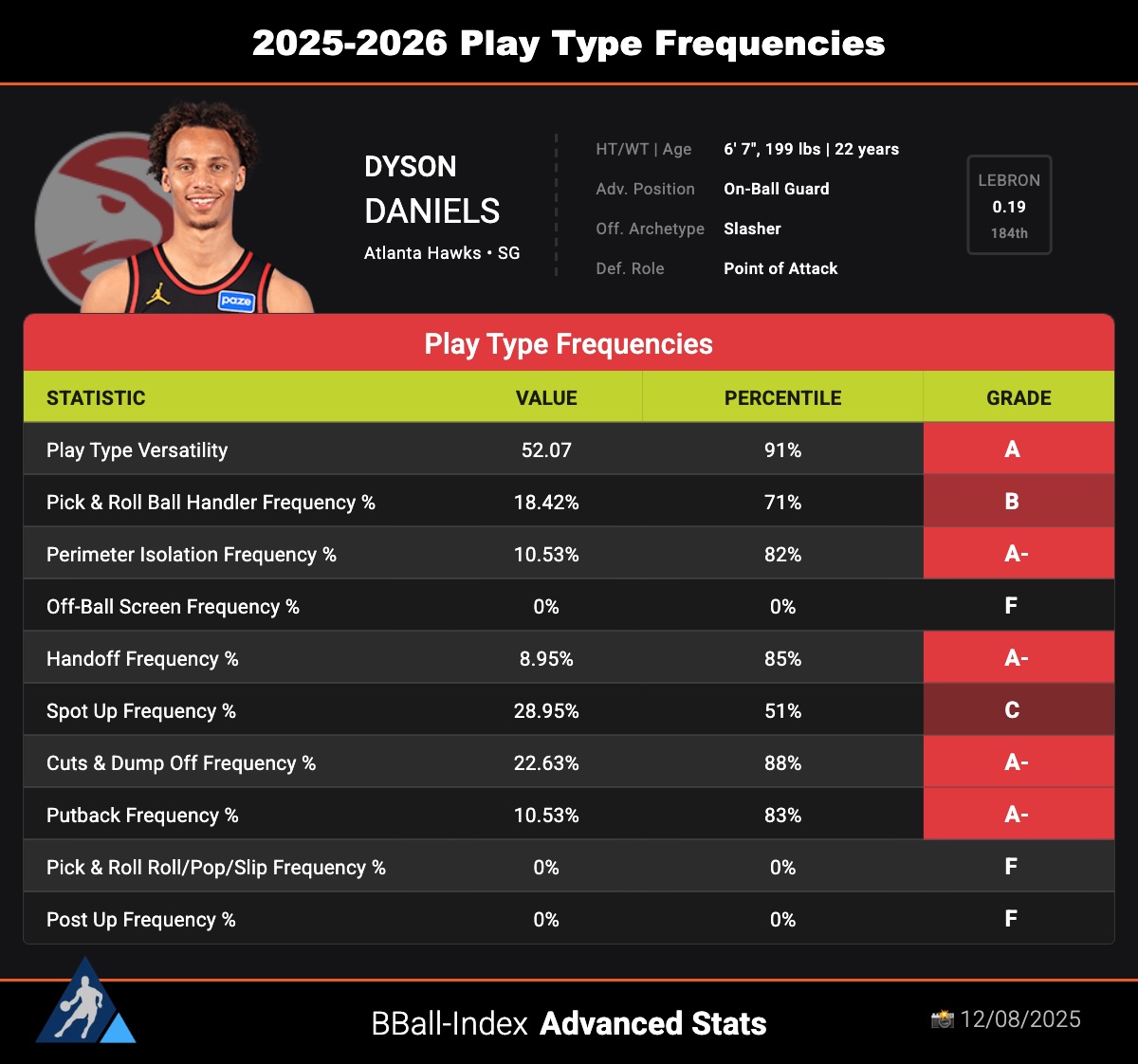
Play Type Usage & Fit
High-value areas
- Play Type Versatility: A (91st percentile) → used in many roles
- Spot-up 29%: C. Limited by shooting
- Cuts 22.6%: A-. Excellent mover, smart cutter
- Perimeter Isolation 10.5%: A- But low efficiency. Good matchup exploiter, not a scorer
- Pick-and-roll ball-handler 18%: B. God passer, poor scorer
Zero usage areas
- Off-ball screens: 0% (F)
- Pick-and-roll roll/pop/slip: 0% (F)
- Post-ups: 0%
He is a slasher-connector-defender, not a movement shooter or high-usage scorer.
Guarded Data (How opponents perform against him)
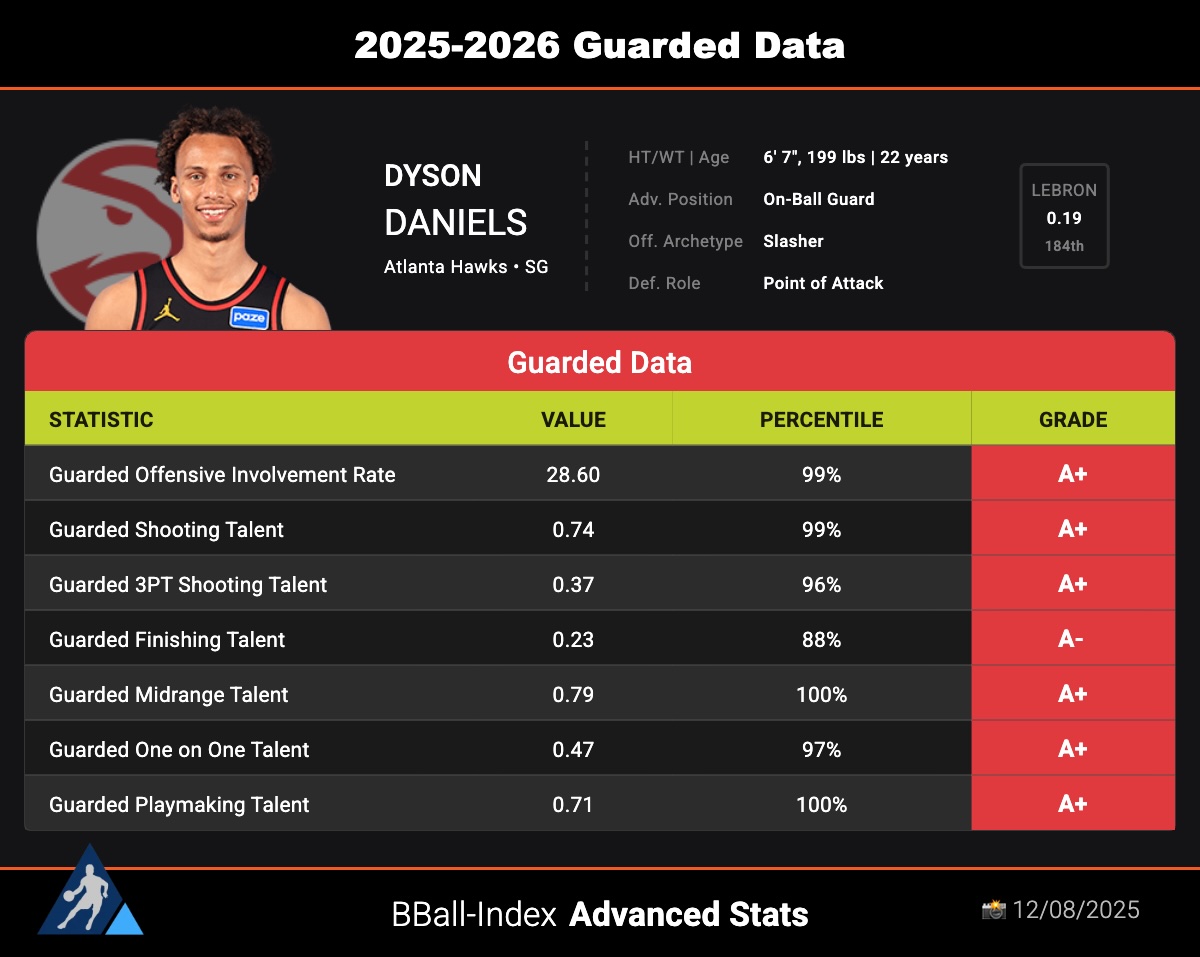
This is where Daniels looks like a future All-Defense lock.
- Guarded Offensive Involvement Rate: A+ (99th percentile)
- Opponents run their offense directly at him — he’s the stopper.
And he holds them far below expectation:
- Guarded Shooting Talent: A+ (99th percentile)
- Guarded 3PT Talent: A+ (96th percentile)
- Guarded Midrange Talent: A+ (100th percentile)
- Guarded One-on-One Talent: A+ (97th percentile)
- Guarded Playmaking Talent: A+ (100th percentile)
Translation
Opponents shoot worse, finish worse, create worse, and pass worse when Dyson is the primary defender. That’s elite disruptive impact.
So, Who is Dyson Daniels right now?
Strengths
- One of the NBA’s best point-of-attack defenders
- Guards stars every night and wins matchups
- Extremely strong defensive advanced metrics (D-LEBRON 93rd percentile)
- Elite passer & advantage creator
- Excellent offensive rebounder for a guard
- Versatile across play types and defensive positions
Weaknesses
- Shooting talent bottom 10% of the league
- One-on-one scoring impact extremely low
- Low gravity limits the functionality of his playmaking
- Limited off-ball shooting role (0% off-screen usage)
- Rim finishing is decent, but not enough to anchor scoring impact
Archetype
High-end defensive guard / secondary creator / connective slasher
A modern Marcus Smart–type statistical profile with less shooting but more length and higher isolation defense ceiling.
The bottom line is Daniels is having a career year while transitioning from a 2 into a 1, learning on the job. Forget the points per decline, Daniels is an emerging superstar that is giving the Hawks pause for thought on Trae Young's future.
Hawks head coach Quin Snyder trusts him, his minutes prove that.
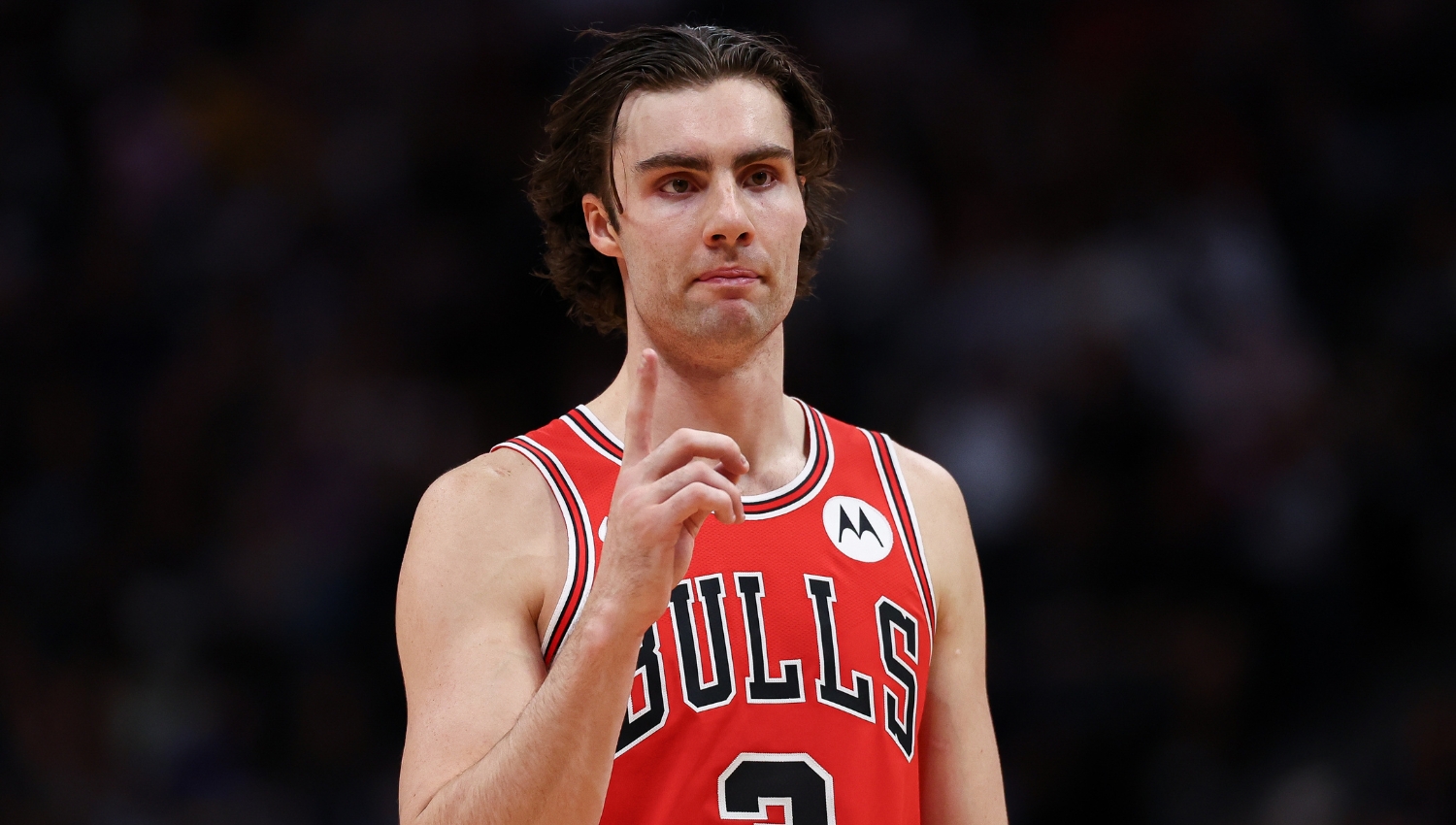
Australia's backcourt of the now and the future is in great hands. Daniels, 22, and Josh Giddey, 23, are world class and still years away from their prime.
But for now, dismiss any notion Daniels isn't a better player this year than last. He is and the numbers prove it and so does his four-year USD $100M contract extension.